AI Chat for Kids: What's Safe, What Isn't, and What Age It Starts
• KidTalk Team
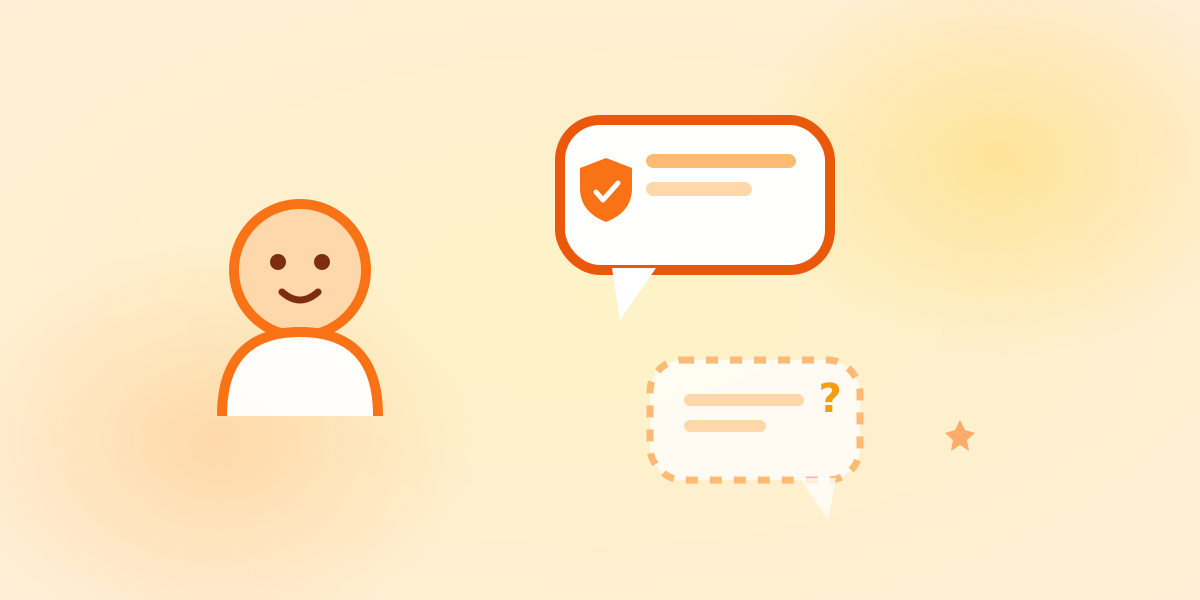
Short answer: “AI chat for kids” is really a question about which kind of chat. General chatbots (ChatGPT, Gemini, Claude) are text-first, adult-designed, 13+ by their own terms, and invisible to parents — not safe for a young child alone, fine for a supervised teen. Purpose-built kids’ AI chat — age-tuned, parent-visible, capped — is workable from roughly the age a child can ask a question, around 3–4 by voice. The one form of AI chat to rule out entirely for children: persona/companion chat apps built for parasocial attachment. Here’s the map.
A parent searching “AI chat for kids” today lands in a mixed crowd: homework bots, adult assistants, anime-persona companions, and children’s products, all answering to the same phrase. Sorting them is 90% of the safety question.
What an “AI chat” actually is
Under every chat product is the same mechanism: a language model predicting good next words, with no built-in sense of true versus plausible and no inherent idea of who it’s talking to. Everything that makes a chat safe or unsafe for a child is added around that core: the audience it’s tuned for, the guardrails, the visibility, the limits. Which is why the product category matters more than the underlying tech — the tech is the same everywhere.
The kinds, sorted for children
| Kind | Example shape | For kids? |
|---|---|---|
| General chatbots | ChatGPT, Gemini, Claude | 13+ with consent by their terms; younger only on a parent’s account, together — the full age guide |
| Kids’ voice AI | Purpose-built companions (ours among them) | From ~3–4; age-tuned answers, parent-visible history, daily caps — the comparison |
| AI tutors | Study-focused chat | From ~8, for schoolwork specifically |
| Persona / companion chat | ”AI girlfriend/boyfriend”, character roleplay apps | Not for children, at any age — see below |
| Smart-speaker assistants | Alexa & co. | Utility commands, not conversation — what differs |
The kind to rule out entirely
One corner of “AI chat” deserves an unambiguous line: apps built around emotional personas — characters designed to form attachment, keep users returning, and simulate relationships. For adults, debatable; for children, no. The mechanics that make them commercially successful — professed feelings, jealousy scripts, “don’t leave me” — are precisely the mechanics a children’s product must never have. A child can healthily enjoy talking to an AI companion; a child should never be the target of engineered attachment. When you evaluate any chat app, this is the first filter: does it want to be useful, or does it want to be loved?
Text chat vs. voice chat — an underrated difference
Most “AI chat” is typed. For children, that detail decides more than it seems:
- Reading/writing gate: typed chat excludes exactly the 3–8 age band whose curiosity is loudest — voice doesn’t
- Length: typed answers run long; spoken answers are naturally short and bounded
- Session shape: text scrolls into open-ended sessions; a spoken exchange has conversational turns — and an end
- Visibility: a typed chat on a private screen is easy to hide; a spoken one is audible in the room
None of this makes text bad for teens. For young children, voice-shaped chat is simply the fitting form.
What age can a child use AI chat?
The question arrives search-phrased as “at what age is it safe for a child to use an AI chatbot,” so here it is plainly:
- ~3–6: voice-based kids’ AI, ideally with a parent nearby at first; general chatbots only as a demonstration on a parent’s account
- 7–12: kids’ AI independently (with visible history); general chatbots on a parent’s account, side by side — good years to teach the checking habit
- 13+: own general-chatbot account permitted by the terms with consent — decide knowingly about the visibility you’re giving up
The fuller version, stage by stage: What Age Can Kids Use AI?
Frequently asked questions
Is AI chat safe for kids at all? The mechanism is neutral; the products differ enormously. A purpose-built, parent-visible, capped kids’ chat used within family rules — yes, workable. An adult chatbot or a persona app in a young child’s hands alone — no. The sorting is the safety.
What’s the safest AI chat for a 5-year-old? At five, the fitting shape is voice-based, age-tuned, capped, and visible to you — the kids’-AI category. Judge any candidate with the six questions; we make one and grade ourselves against the same list.
How do I know if a chat app is a “persona” app? Check the marketing: words like companion-with-feelings, relationship, “always there for you,” romantic framing, or characters begging users to stay. Any one of these, for a child, is disqualifying.
Can AI chat help with homework? It can — which is exactly the problem to manage. The line that works: AI for growing the question, the child for producing the answer.
In summary
- “AI chat” spans adult tools, kids’ products, tutors, and persona apps — safety differs by kind, not by tech
- General chatbots: 13+, or together on your account
- Kids’ voice chat: from ~3–4, if visible, tuned, and capped
- Persona/attachment chat: not for children, full stop
- Voice, for young children, beats text on every child-relevant axis
The searchable question is “is AI chat safe for kids” — the useful question is “which chat, and can I see it?” Answer the second, and the first answers itself.
Ready to try KidTalk?
Turn your child's curiosity into stories with safe, friendly AI.
Get started for free