Why You Shouldn't Correct Your Child's English Mistakes
• KidTalk Team
Short answer: Don’t correct your child’s English — not through the elementary years, anyway. This isn’t softness; it’s mechanics. ① Most early “mistakes” are normal acquisition stages that disappear on their own. ② What correction reliably reduces isn’t the error — it’s speaking volume, and volume is the fuel of acquisition. ③ There’s a better move for every moment you’re tempted: the recast — a natural restatement inside the conversation. Here’s each part.
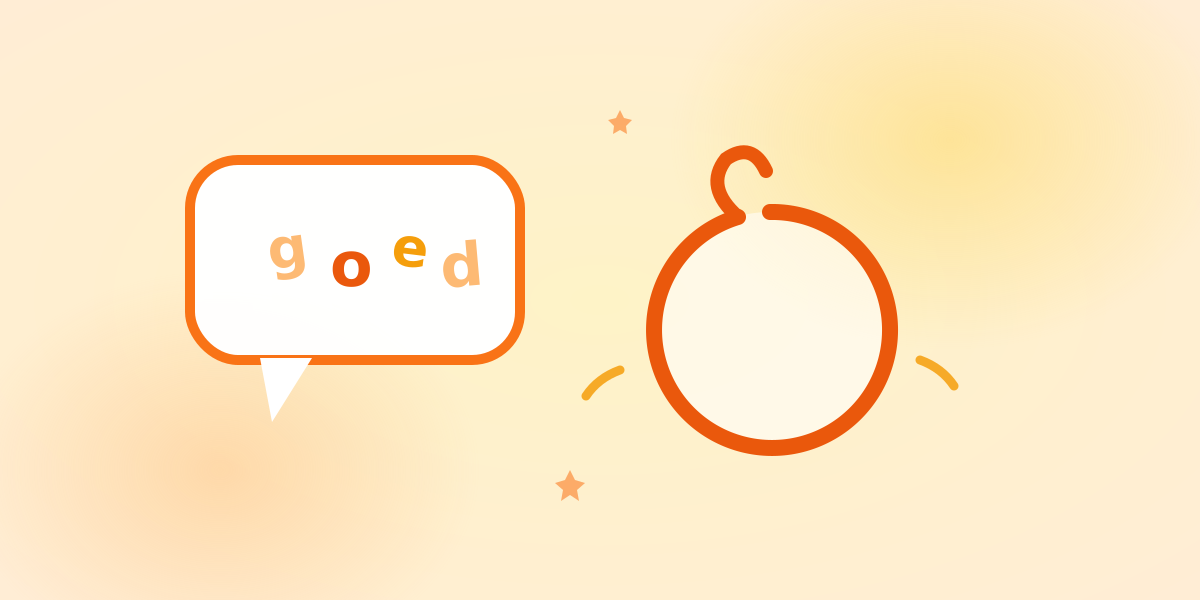
“I goed to the park yesterday!” — delivered with a grin. Every fiber wants to say went, not goed. The instinct is loving. It’s also the most expensive sentence available.
That mistake is progress wearing a disguise
“Goed” isn’t random. It’s proof your child independently discovered a rule — past tense adds -ed — and applied it boldly. Language researchers call this overgeneralization, and it appears in every healthy acquisition path, first language or second. (Japanese children do it too: こわいかった, 食べれる.) Which means most errors aren’t defects to repair but stairs mid-climb — and stairs pass by themselves, as long as the climbing continues. The fuel for climbing is output.
Correction doesn’t reduce the error — it reduces the speaking
The crux. What research and classrooms keep observing about explicit correction of young learners:
- The error itself improves only marginally — stage-based errors resurface until the stage passes, whatever you say
- Meanwhile, repeated correction reliably shrinks total speech — the child learns that silence can’t be wrong
It’s the same structure as our “never correct pronunciation” rule. At this age English has exactly one KPI: willingness to open the mouth. Correction is the fastest known way to spend it. An entire generation of Japanese adults who “can’t speak English because I’m afraid of mistakes” is, in a sense, the long-term dataset.
Three moves that beat the red pen
1. The recast
Child: “I goed to the park!” Parent: “Oh, you went to the park! Was it fun?”
No flag, no lesson — the correct form arrives inside a living reply. It’s the best-supported response in the research, and the child showers in correct forms without ever feeling marked. The rule of the recast: the conversation continues afterward. The conversation is the point; the restatement is a stowaway.
2. React to the content, at full volume
Child: “I see… big… dog! Park!” Parent: “You saw a BIG dog at the park?! What color was it?”
Grammar collapsed; communication succeeded — react to the success. Every “my English worked” moment makes the next sentence easier, and it’s the turns that build language, so the priority is always: don’t stop the rally.
3. Smuggle the form into a question
Child: “I like play soccer.” Parent: “Nice! What do you like to play with your friends?”
The correct pattern rides inside your question; answering makes the child touch it again. No teaching — just more contact.
The honest exceptions
① The child asks — “is this right?” A requested correction is an answer, not a correction. Give it briefly, praise, move on. ② A meaning-changing confusion is settling in (yes/no reversed, say) — handle by raising exposure to the right form rather than flagging. ③ An older child prepping for a test asks for grammar — that’s study consultation; teach away.
Where the AI stands on this
Full disclosure: KidTalk’s Poppy is designed not to correct children’s English. Broken English (“I favorite sport is hockey”) gets a natural conversational reply containing natural English — structurally, a recast. That’s not a missing feature; it’s this article implemented. Conversely, when you evaluate English apps that grade and flag every error, look at them through this lens: what does that design do to your child’s willingness to speak?
Frequently asked questions
Won’t uncorrected mistakes become permanent? Stage-type errors (the goed family) resolve as stages pass, provided input and output keep flowing. Meaning-level confusions get the exposure treatment above. The thing far more likely to become permanent is the silence correction teaches.
School corrects — should home match? The opposite. Because school handles accuracy, home’s unique value is being the one place where mistakes are free. Call it division of labor.
My own English isn’t good enough to recast. It doesn’t need to be. A parent who makes mistakes in English is a gift — “Went… I think!” said with a laugh builds exactly the house where mouths open.
Pronunciation too? Especially pronunciation. Comprehensible is the goal; native is not. Pronunciation call-outs wire directly to embarrassment, and all they buy is silence.
In summary
- “Goed”-type errors are self-discovered rules — progress, not defects
- Correction barely touches the error and reliably shrinks the speaking
- Instead: recast · react to content · smuggle forms into questions
- Requested corrections are answers — give those freely
- Home’s role: the one place mistakes cost nothing
Save the red pen for the day they ask for it. What your child’s English needs now is only the big warm circle.
Ready to try KidTalk?
Turn your child's curiosity into stories with safe, friendly AI.
Get started for free