It's the Turns, Not the Words: What Actually Drives Language Development
• KidTalk Team
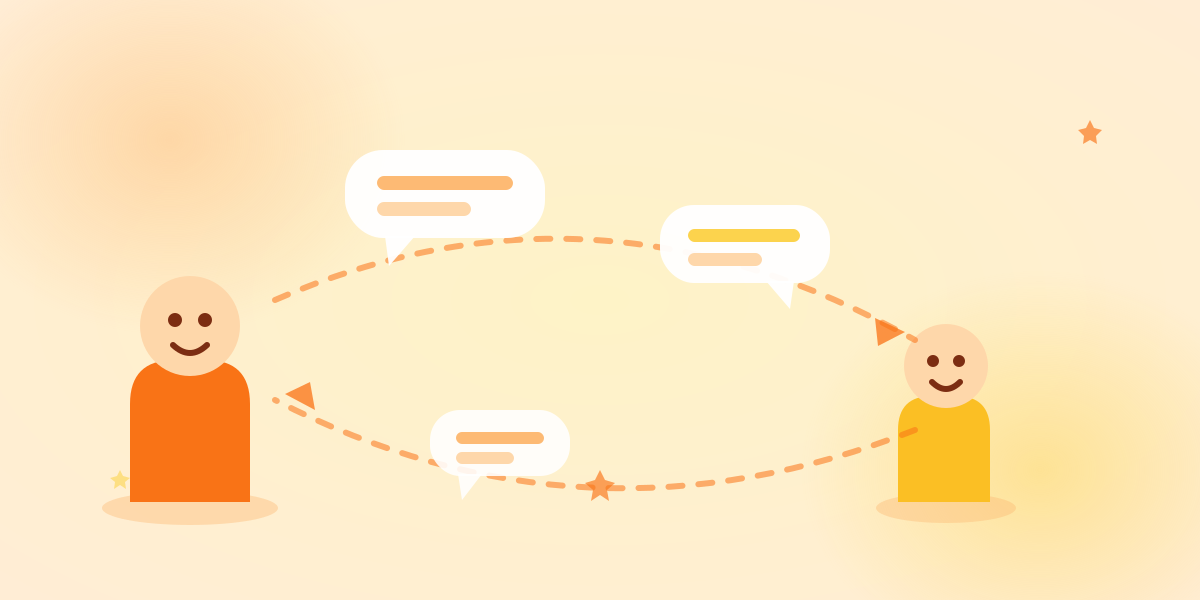
Short answer: What supports a child’s language isn’t the volume of words adults produce — it’s the number of back-and-forth turns in the conversation. In research, conversational turns predicted children’s language scores and brain activity better than adult word count did. A shorter conversation the child answers in beats a longer one they only receive.
“Talk to your child as much as possible.”
You’ll hear it in parenting books and at check-ups. It isn’t wrong. But research over the last several years points at something more specific.
It’s the turns, not the word count.
The famous “30 million word gap”
In 1990s America, a well-known study reported that by age three, children from different socioeconomic backgrounds had heard as many as 30 million more or fewer words (Hart & Risley, 1995).
The “word gap” was cited worldwide and became the basis for a lot of “just talk more” advice.
Since then the study has drawn methodological criticism, and questions about replication remain open. But the more interesting problem was different: it only counted volume.
Turns explained more than words did
In 2018, a research team from MIT and Harvard recorded conversations at home for children aged four to six while also measuring brain activity with fMRI (Romeo et al., Psychological Science, 2018).
The results were clear.
- The sheer number of words adults spoke explained relatively little about differences in children’s language ability
- Conversational turns — adult and child alternating — were strongly associated with language scores
- Children with more turns showed greater activation in Broca’s area, a region involved in language processing
- The association held after statistically adjusting for socioeconomic background
That last point matters. It wasn’t affluence doing the work. It was how the conversation went.
That’s a hopeful finding for parents, because it’s about method rather than money or vocabulary.
Why turns do the work
It makes sense on reflection.
When a child is being talked at, their brain only receives. But when it’s their turn to reply, several things happen at once:
- They must understand what was said
- They must convert their own thought into words
- They must anticipate the other person’s reaction
- If it doesn’t land, they must rephrase
Those four are what build language. The fourth in particular — repair — simply never occurs in one-directional talk.
This is also the best explanation for why heavy video watching doesn’t translate into language gains. A screen never waits for the child’s reply.
Five things to do at home
1. Ask questions that can’t end in yes or no
- ✗ “Did you have fun at nursery?” → “Yeah.” (one turn, over)
- ✓ “What was the best bit today?” → the conversation continues
Changing the shape of the question multiplies the turns.
2. Wait three seconds
Adults can’t wait. We can’t tolerate the pause while a child assembles a thought, so we fill it in for them.
Count to three silently. That’s it. It gives the child time to find their own words, and it’s the single easiest way to add turns.
3. Expand what your child says
Language researchers call this “expansion,” and it’s easy to use at home.
Child: “Doggy there.” Parent: “Yes — a big brown doggy was there. Where was it?”
Take the child’s words, don’t correct them, enrich them slightly, and add a question. You model vocabulary and keep the turn going at the same time.
4. Ask rather than narrate
“Right, bath time, let’s wash your body, now your hair.” Narration racks up word count and produces zero turns.
“What shall we wash next?” produces a turn. The same moment, reshaped as a question, changes value entirely.
5. With picture books, talk more than you read
Reading aloud is a wonderful habit, but reading the words as printed generates no turns.
Stop mid-page: “What do you think she’ll do?” “Why has he got that face on?” Wandering off the page is worth more, linguistically, than finishing the book.
Does talking to an AI count as a “turn”?
Here we want to be straight with you.
What we can say: Talking to a voice AI like KidTalk does produce turns structurally. The child speaks, the AI responds, the child speaks again. It isn’t one-directional the way video is. Poppy Bot is deliberately designed never to stop at “great question!” but to add something — precisely to keep that exchange going.
What we can’t say: We can’t tell you that using KidTalk improves language ability. The research above measured human conversation, not conversation with an AI. Children’s voice AI is a new field, and long-term evidence doesn’t yet exist. We’re not going to pretend otherwise.
Where we stand: Talking to an AI is not a substitute for talking to people. Conversations with parents, teachers and friends have no equal. KidTalk exists to add a few turns during the hours when those are physically impossible — cooking, driving, seeing to a sibling.
And if your child later tells you about what they discussed with Poppy, that’s the most valuable turn in the whole chain. “What did you and Poppy talk about today?” does more than the app does.
For more on voice interfaces and young children, see Why speaking works, and for busy-hour use, Answering “listen to me!”.
Frequently asked questions
So is more talking always better? Volume alone has limited effect. In the research, turns tracked children’s language ability better than adult word count. A shorter exchange the child participates in beats a longer monologue.
My child only says single words. Does that count as a turn? Yes. “Doggy” answered with “yes, a big doggy!” — and then the child says something else — is a genuine turn. What matters is the exchange, not the length of the utterance.
Are educational videos useless for language? Content can be valuable, but passive watching generates no turns. Watching alongside your child and talking during it changes the value completely. It’s less about the screen than about whether conversation happens around it.
We both work and don’t have much time. Density matters more than duration. Fifteen minutes with open questions and three-second pauses accumulates a lot of turns — often more than a long stretch of being in the same room.
In summary
Language grows on the conversations that come back, not the words poured out.
- Ask questions that can’t end in yes or no
- Wait three seconds
- Expand what your child says
- Turn narration into questions
- Stop mid-book and talk
All free, all available today. And remember — you don’t have to be good at talking. You just have to hand your child the turn.
Ready to try KidTalk?
Turn your child's curiosity into stories with safe, friendly AI.
Get started for free