Why Voice-First AI Is Perfect for Children Who Can't Read Yet
• KidTalk Team
The AI Gap No One Talks About
AI assistants are everywhere now. Adults type a question, read the response, and move on. It feels effortless — if you can read and type.
But think about a three-year-old. She can’t spell her own name yet, let alone type a prompt into a chat window. Even if she could dictate a question through voice input, the answer would appear as a wall of text she can’t decode. The vast majority of AI tools assume literacy as a baseline. That means children between the ages of two and five — the very age group that absorbs language fastest — are locked out of the conversation entirely.
This is the gap that voice-first AI is designed to close.
Why Text-Based AI Falls Short for Young Children
The barriers aren’t just about reading. Text-based AI interfaces present a stack of problems for pre-reading children.
Input is impossible. Typing on a phone keyboard requires fine motor skills and letter recognition that most toddlers don’t have. Even voice-to-text features require the child to find and hold a button, and the transcribed result still appears as text.
Output is inaccessible. General-purpose AI assistants generate long, nuanced responses written for adults. The vocabulary, sentence length, and conceptual density are all wrong for a young child — even if a parent reads the response aloud.
The interaction becomes passive. When a child can’t drive the conversation independently, they end up watching a parent interact with a device. That’s observation, not participation. The child isn’t building language skills; they’re just waiting for something interesting to appear on screen.
Voice Is How Children Already Communicate
There’s a reason speech comes before reading in every child’s development. Babies start by listening, then babbling, then forming words, then stringing sentences together. Reading and writing arrive years later, built on the spoken language foundation.
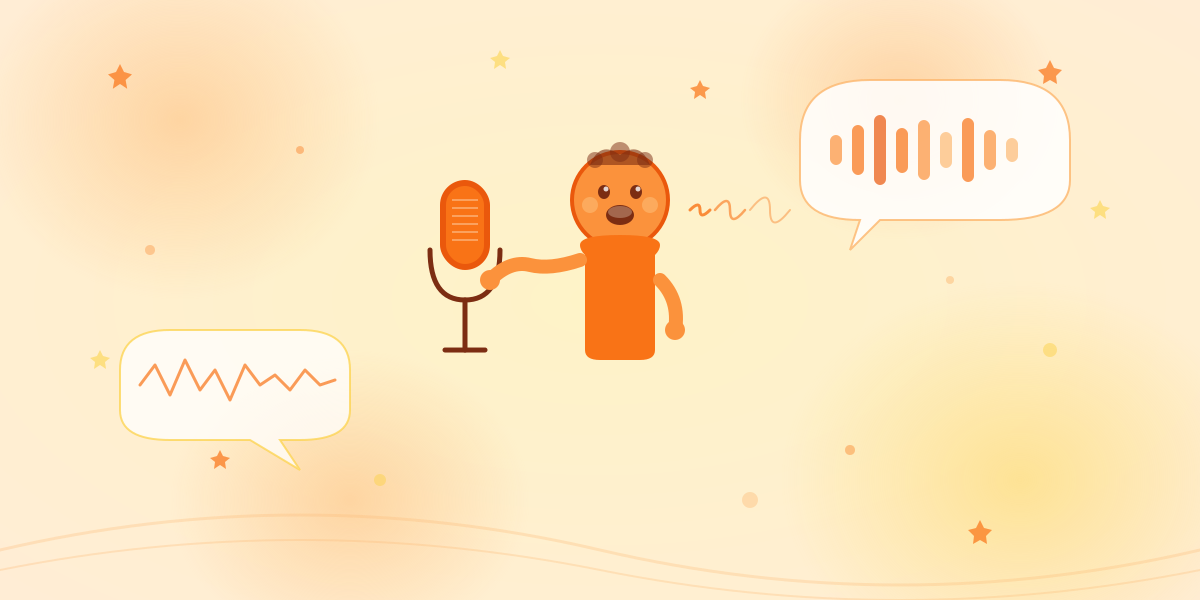
Voice-first AI respects this developmental sequence. The child speaks into a microphone, and the AI responds with spoken audio. No text input, no text output. The interface matches the communication mode the child already uses every day — talking and listening.
KidTalk is built around this principle. A child taps a single button, speaks, and hears the AI’s response as natural speech. The entire experience stays within the realm of what a two-year-old can already do: use their voice.
How the Speak-Listen Cycle Builds Language
Research on early language acquisition consistently points to one finding: interactive conversation drives vocabulary growth far more effectively than passive listening. Hearing words on television or through audiobooks helps, but the real acceleration happens when a child speaks and receives a relevant response.
Voice AI creates this loop naturally. A child asks, “Why do birds fly?” The AI answers in age-appropriate language. The child hears something new — maybe the word “feathers” or “wings” used in a way they haven’t encountered before — and follows up with another question. Each cycle introduces new vocabulary in context, which is how young children learn words most effectively.
The key advantage over passive content is that the child has to formulate their own thoughts. They’re not choosing from a menu or tapping a pre-written option. They’re deciding what to say, finding the words for it, and producing a spoken sentence. That active construction of language is where the developmental benefit lives.
Why 10 Seconds per Turn Is the Right Constraint
KidTalk limits each recording to 10 seconds. That might sound restrictive, but it’s a deliberate design choice grounded in how young children actually communicate.
Children between two and five don’t speak in long monologues. They communicate in short bursts — a question here, a comment there, a reaction to what they just heard. A 10-second window is enough to express one complete thought, which is exactly the unit of communication that feels natural at this age.
Short turns also teach conversational rhythm. The back-and-forth pattern of “I talk, then I listen, then I talk again” mirrors real human conversation. Children who practice this pattern develop better turn-taking skills, which matter in every social interaction from playground conversations to classroom discussions.
There’s a practical benefit too. Long, open-ended recording can lead to rambling or silence as a child loses their train of thought. A short, focused window keeps the interaction snappy and rewarding. The child says something, gets a response quickly, and stays engaged.
Active Voice vs. Passive Screen Time
Parents are right to be cautious about screen time. But not all device use is created equal.
Watching a video is a passive experience. The content flows regardless of whether the child is paying attention, responding, or even in the room. The child’s brain is in reception mode — taking in information but not actively producing anything.
A voice AI conversation flips that dynamic. Nothing happens until the child speaks. They have to initiate, articulate, listen, comprehend, and respond. Every turn requires active cognitive engagement. The child is a participant, not a spectator.
This distinction matters more than total minutes spent with a device. Ten minutes of back-and-forth voice conversation with an AI involves more language processing than thirty minutes of watching an educational cartoon. The active ingredient isn’t the content — it’s the act of producing and responding to language in real time.
That said, voice AI isn’t meant to replace every other form of media. It’s one tool among many. The point is that when a child does spend time with a device, a voice-based conversation offers something that passive viewing simply cannot.
Signs of Growth Parents Can Watch For
Language development through voice AI conversations tends to show up in subtle, everyday ways rather than dramatic breakthroughs. Here are a few things parents might notice over time.
Questions become more sophisticated. Early on, a child might ask simple “what” questions: “What’s that?” or “What does a cow say?” Gradually, “why” and “how” questions start appearing: “Why is the sky dark at night?” or “How do fish breathe underwater?” This shift signals growing curiosity and more complex thinking.
Explanations get longer and more structured. When you ask your child about their day, you might notice they’re starting to sequence events — “First I played, then I ate, then I drew a picture” — rather than offering a single-word answer. Exposure to the AI’s structured responses gives children a model for organizing their own thoughts.
New vocabulary shows up in daily conversation. A child who talked to the AI about dinosaurs might suddenly use the word “enormous” instead of “big,” or refer to a “herbivore” at dinner. These borrowed words are signs that the conversational exposure is sticking.
Listening patience improves. The turn-taking rhythm of voice AI practice — speak, then wait, then listen fully before speaking again — can carry over into human interactions. Some parents notice their child interrupting less or waiting more patiently for others to finish speaking.
None of these changes happen overnight. Language growth is gradual and cumulative. But knowing what to look for helps parents recognize the progress that’s already underway.
Meeting Children Where They Are
Every child learns to speak before they learn to read. Voice-first AI simply builds on that reality. Instead of asking children to adapt to a text-based interface they can’t use, it meets them where they already are — in the world of spoken language.
KidTalk exists because we believe that a child who can talk is a child who can explore ideas, ask questions, and grow their understanding of the world. No keyboard required. No reading skills necessary. Just a voice, a microphone, and a conversation waiting to happen.
Ready to try KidTalk?
Turn your child's curiosity into stories with safe, friendly AI.
Get started for free