Your Child's New Language Buddy: How AI Conversations Build Bilingual Skills Naturally
• KidTalk Team
The Language Window You Don’t Want to Miss
Every parent wants the best for their child, and for many families, that includes exposure to more than one language. Whether you speak two languages at home, live in a multilingual community, or simply want your child to hear a second language early, the instinct is sound. Young children are remarkably good at absorbing new languages, and the earlier they start hearing one, the more natural it becomes.
But here is the catch: most formal language programs are not designed for how young children actually learn. Sitting still, repeating phrases, memorizing vocabulary lists. These methods work fine for older students. For a three- or four-year-old, they can turn language learning into a chore before it ever becomes a joy.
What if there were a way to give your child regular, low-pressure exposure to a second language, right at home, on their own schedule, through something they already love doing: talking?
Why Pressure Backfires with Young Learners
There is a well-documented phenomenon in early childhood education: the harder you push structured learning on very young children, the more likely they are to resist it. This is not stubbornness. It is how developing brains work. Young children learn best through play, exploration, and social interaction, not through drills and correction.
Language acquisition follows the same pattern. Babies do not learn their first language from textbooks. They learn it by being immersed in it, by hearing it in context, by trying to communicate and being understood even when they get things wrong. The emotional experience matters as much as the linguistic input. A child who feels safe, relaxed, and engaged will absorb far more language than one who feels anxious about making mistakes.
This is why many early language programs, despite good intentions, struggle to produce lasting results. The environment is too formal, the stakes feel too high, and the child associates the new language with stress rather than curiosity.
Voice AI: A Judgment-Free Conversation Partner
This is where voice-based AI conversations offer something genuinely new. Not as a replacement for human interaction, but as a complement that fills a gap most families cannot fill on their own.
KidTalk is a voice-first app where children speak to a friendly AI companion and hear a voice response. There is no reading required, no typing, no screen-based interaction beyond pressing a single button. The child talks, and the AI talks back. It is as close to natural conversation as technology currently allows.
For language exposure, this format has several meaningful advantages.
First, it is always available. You do not need to coordinate schedules, drive to a class, or find a conversation partner who speaks the target language. Five minutes before bedtime, ten minutes on a rainy afternoon, whenever the moment feels right.
Second, it is patient and nonjudgmental. The AI never corrects pronunciation, never sighs at a repeated question, never signals that the child is getting it wrong. It simply continues the conversation. For a young child building confidence in a new language, this kind of unconditional responsiveness is invaluable.
Third, it follows the child’s interests. If your child wants to talk about trains in English for the fifth day in a row, the AI is happy to oblige. Interest-driven conversation is far more effective for language acquisition than topic-driven curricula, because the child is genuinely motivated to understand and be understood.
How KidTalk Handles Two Languages
KidTalk currently supports Japanese and English, and the way it handles bilingual conversations is designed to feel natural rather than instructional.
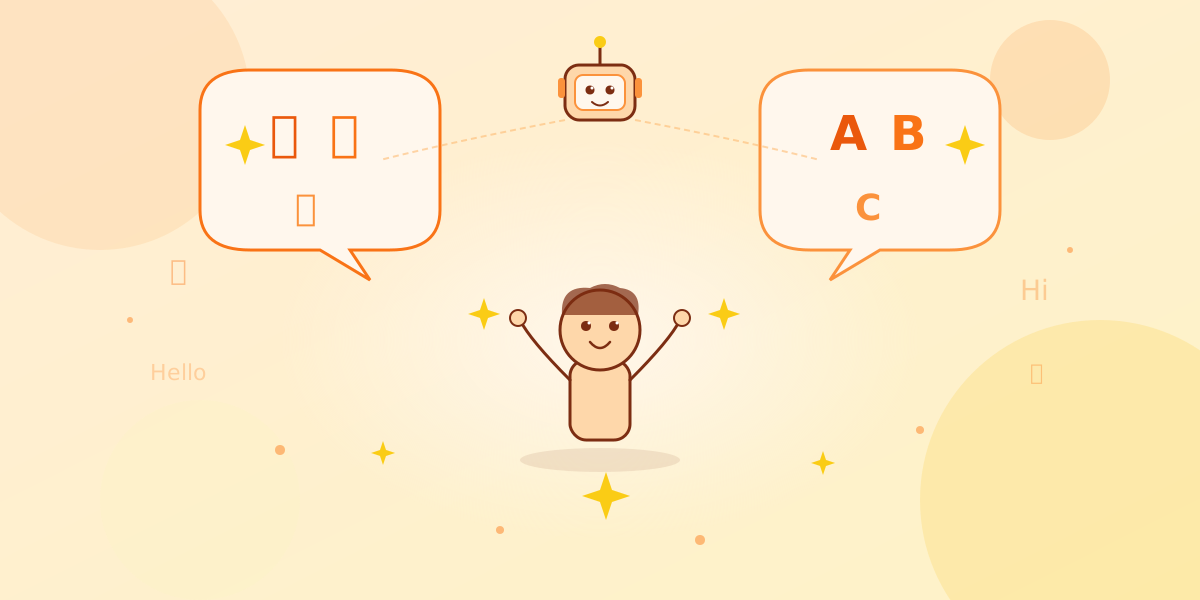
The AI automatically detects which language the child is speaking and responds in the same language. A child can start a conversation in English, switch to Japanese mid-sentence, and the AI will follow along. This mirrors how bilingual children actually communicate: fluidly, mixing languages as needed, without treating the switch as an error.
Parents also have the option to set the AI’s response language from the app settings. This is useful for creating intentional language exposure. You might decide that Tuesday evenings are “English time” and set the AI to respond in English regardless of which language your child uses. The child can still speak in their dominant language, but they hear the response in the target language, building comprehension naturally.
This approach works well for multilingual families too. A child whose home language is Japanese but who is learning English at school can use KidTalk as a bridge, practicing conversational English in a safe space without the social pressures of the classroom.
What the Research Says About Early Exposure
Decades of research in developmental linguistics point to a consistent finding: the quantity and quality of language input in the first six years of life have an outsized impact on long-term language ability.
Patricia Kuhl’s research at the University of Washington showed that infants can distinguish the sounds of all human languages up to about ten months of age. After that, the brain begins to specialize in the sounds it hears most frequently. Children who continue to receive input in a second language retain their ability to perceive and produce its sounds for much longer.
Studies on bilingual children also show cognitive benefits beyond language itself. The constant practice of switching between two language systems strengthens executive function, the set of mental skills that includes attention control, working memory, and cognitive flexibility. These benefits appear even when the child is not fully fluent in both languages. Regular exposure, not perficiency, is what matters.
Importantly, the research also shows that the emotional context of language exposure matters. Input that comes through warm, engaging interaction produces better outcomes than passive exposure, such as background television in a foreign language. This is why conversation, even with an AI, is more effective than simply playing foreign-language media in the background.
Practical Tips for Parents
If you are considering using KidTalk to add a second language to your child’s world, here are some approaches that work well.
Start with your child’s strongest interest. If they are obsessed with animals, start there. “Can you tell me about elephants?” in the target language gives the AI something concrete to discuss, and your child has built-in motivation to understand the answer.
Keep sessions short. Five to ten minutes is plenty for young children. The goal is to end while the child is still enjoying themselves, so they want to come back tomorrow. Consistency matters more than duration.
Do not correct. If your child mixes languages, pronounces something unusually, or says something grammatically creative, let it go. They are experimenting, and that experimentation is exactly how language acquisition works. The AI will model correct usage naturally in its responses.
Make it part of a routine. Attaching language time to an existing habit, like after dinner or before a bedtime story, helps it become automatic. When it is just part of what you do, it stops feeling like a lesson.
Talk about the conversations afterward. Ask your child what the AI said, what they learned, whether the AI said anything funny. This kind of reflection deepens learning and signals to your child that you value the experience.
Planting Seeds, Not Forcing Growth
It is tempting to set ambitious goals for your child’s language development: fluency by age five, bilingual school readiness, test scores. But for very young children, the most valuable thing you can do is simpler than that. You can help them understand that other languages exist, that people use them to communicate, and that trying to speak a new language is something fun and safe to do.
KidTalk is not a language school. It will not replace immersion, travel, or growing up in a bilingual household. What it can do is give your child regular, joyful, zero-pressure exposure to a second language, woven into the fabric of their everyday life. That exposure plants seeds. Some will sprout quickly. Others will sit dormant until a future experience, a trip abroad, a new classmate, a song on the radio, brings them to life.
The most important thing is that those seeds are there when the moment comes.
Ready to try KidTalk?
Turn your child's curiosity into stories with safe, friendly AI.
Get started for free