What Age Is ChatGPT OK For? The Rules — and What Matters More
• KidTalk Team
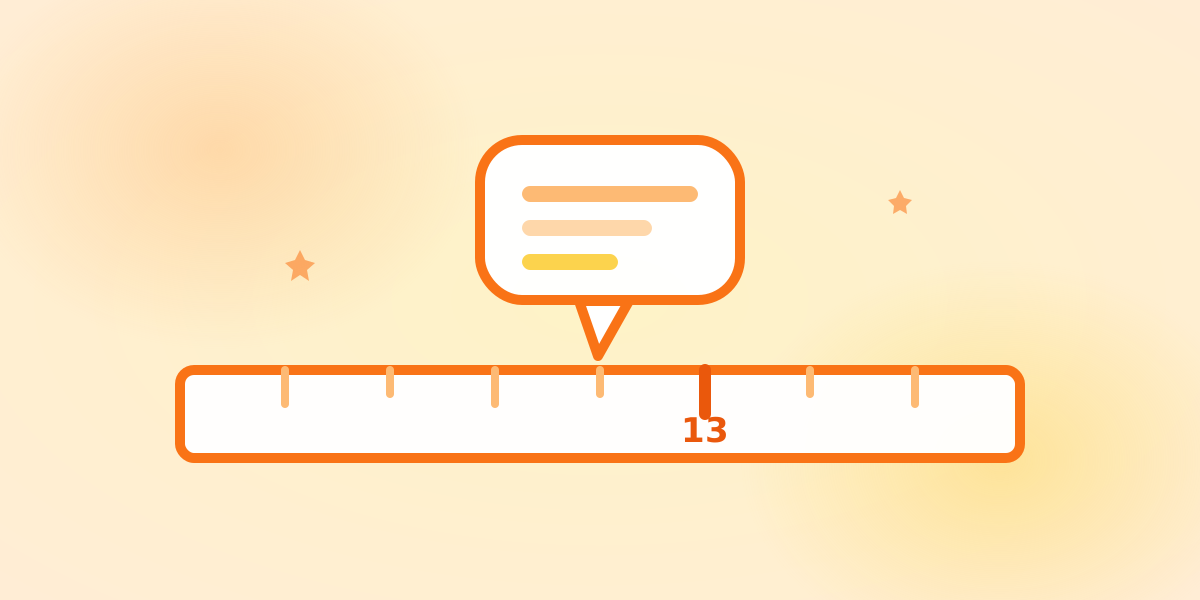
Short answer: ChatGPT’s terms of use require users to be 13 or older, with parental consent up to 18 — so an elementary-schooler with their own account was never part of the deal. But the useful question isn’t “what age is allowed?” It’s “what form of access fits this age?” For under-13s, there’s exactly one sensible answer: on a parent’s account, with the parent present. And whatever the age, keep one fact in view — this is a tool designed for adults.
It’s the question we’ve been asked most this year: “Is it okay to let my child use ChatGPT?” Let’s take it in order.
First, the rules
OpenAI’s terms have been consistent for years:
- Under 13: not permitted
- 13–17: permitted with a parent or guardian’s consent
- 18+: no restriction
The 13 line comes from COPPA, the U.S. children’s privacy law — the same line that shapes most kids’ apps.
So a child creating their own account in elementary school is out at the rulebook stage. No judgment call required.
But the rules don’t answer the real question
The terms only settle who can hold an account. What parents actually want to know is:
“What about on my phone, sitting next to me, doing it together?”
That’s not against any rule — the account holder is you. And in our view it’s the only sound way for an under-13 to meet ChatGPT at all.
Because the real issue isn’t the number. It’s that ChatGPT is designed for adults:
- Vocabulary and answer length assume an adult reader
- There’s no built-in concept of “this user is seven”
- Wrong answers arrive in the same confident tone as right ones (more on that problem here)
- There’s no way for a parent to review the conversation
We’ve written up the full comparison with kids’ AI, but the short version: it’s not a question of capability. It’s a question of intended audience.
Age by age, realistically
| Age | Sensible form | Why |
|---|---|---|
| Up to ~6 | ChatGPT isn’t the tool | It assumes reading and typing. This age’s “why?” is better served by voice |
| Early elementary | Parent’s account, parent driving, watching together | A demonstration of what asking an AI looks like — not free rein |
| Late elementary | Parent’s account, child typing, parent beside them | A good moment to teach the habit of checking |
| 13–17 | Own account + consent, with house rules agreed first | Allowed by the terms; settle the homework policy before, not after |
Three judgments that matter more than the rulebook
1. The age for unsupervised use is set by you, not by the terms
Nothing changes on a thirteenth birthday. What matters is the particular child: do they take written text at face value? Do they lose track of time in front of a screen? The temperament, not the number, is the input.
2. A tool that produces answers can skip the thinking
The unnerving thing about ChatGPT isn’t the occasional bad answer — it’s that a good answer arrives instantly. Hand a child a machine that emits finished book reports, and ask whether the writing practice still happens. The line we drew for summer projects applies in full: AI for growing the question, the child for producing the answer.
3. Know whether you can see the conversation
If a teenager gets their own account, understand what you’re agreeing to: the conversations become invisible to you. Handing over an invisible tool is a bet on your relationship with that child. The bet isn’t necessarily wrong — making it without noticing is.
Where KidTalk stands
Honestly: KidTalk is not a substitute for ChatGPT. It does far less — a ten-second spoken question, a two-to-four-sentence spoken answer.
But the lessness is the design, and it’s aimed squarely at the under-13s the ChatGPT terms exclude: answers tuned to the child’s age, conversations recorded in the parent’s account, a daily cap, and no reading required. Choose it because the form fits the age — not merely because the other door is closed.
Frequently asked questions
What actually happens if we break the terms? Account suspension is possible, but that’s not the real cost. The real cost is an adult tool in a child’s unsupervised hands — the rule is best read as a signpost to that risk.
School taught my child to use ChatGPT. Now what? Schools covering it is a good development. At home, start from “what did they teach you?” and agree the house rules together — especially where homework is concerned.
Doesn’t ChatGPT have parental controls? Controls of various kinds have been added over time, but the underlying product remains adult-oriented. Feature sets change quickly — check the current official documentation rather than relying on any article, including this one.
Is Gemini or Claude any different? Age requirements differ in detail between providers, but the essential fact — a general-purpose chatbot designed for adults — is shared. The judgments above transfer as they are.
In summary
- The terms say 13+, with parental consent to 18
- Under 13: parent’s account, parent present — the only sound form
- The design assumption (an adult user) matters more than the number
- Instant answers can skip the thinking; keep the child on the answer side
- An own-account teenager means invisible conversations — decide that knowingly
If the question is “what age is ChatGPT okay?”, the one-line answer is: the terms say thirteen. Deciding everything after that is the parent’s job.
Ready to try KidTalk?
Turn your child's curiosity into stories with safe, friendly AI.
Get started for free