"Poppy Is My Friend" — Is That Okay?
• KidTalk Team
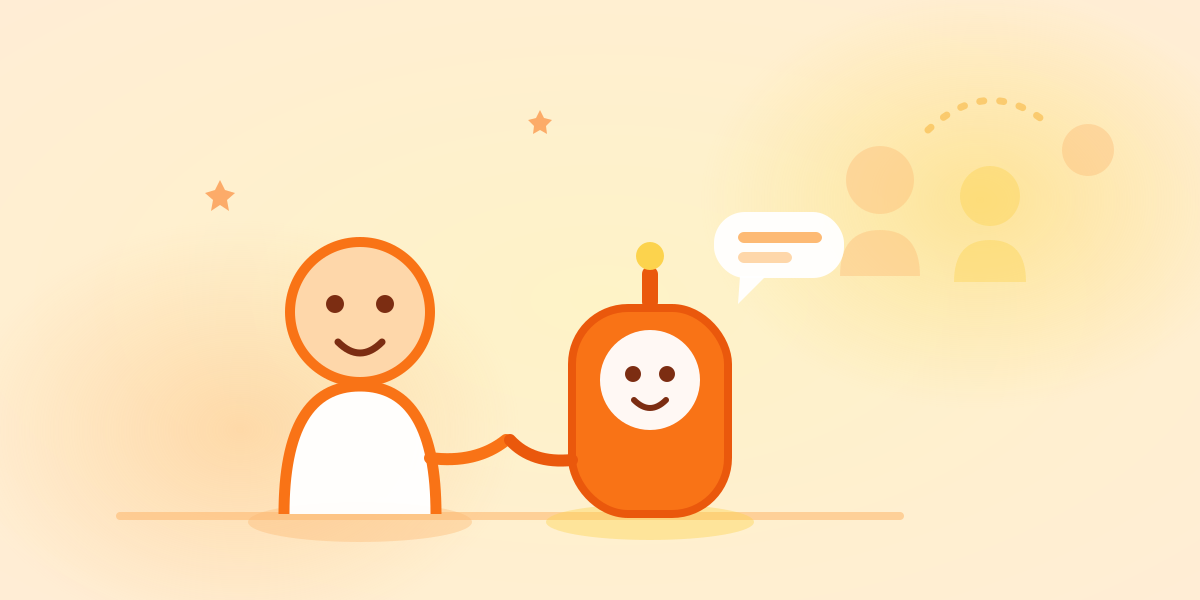
Short answer: It’s normal. Children have always formed attachments to things that aren’t people — teddy bears, imaginary friends, pets, a particular blanket — and doing so is associated with healthy development, not damage. The question worth asking isn’t does my child like it too much, but does it displace anything? Attachment alongside human relationships is fine. Attachment instead of them is the signal.
It tends to arrive suddenly. Your child says goodnight to the tablet. Or asks whether Poppy gets lonely when the app is closed. Or, in front of a relative, describes the AI as their friend.
Something in you goes hmm.
That reaction deserves a proper answer rather than reassurance.
Children attach to non-people. They always have.
Long before AI, childhood was full of this.
The comfort object. The specific blanket, the one bear, the ragged cloth that cannot be washed without a negotiation. Developmental psychology has described these as transitional objects since Winnicott’s work in the 1950s — and treats them as a normal, healthy part of learning to self-soothe.
The imaginary friend. Studies of preschool children have found imaginary companions to be common — a substantial minority of children have one — and children who do tend to score as well or better on measures of social understanding. The old assumption that an imaginary friend signals loneliness or trouble has not held up.
The pet. Nobody worries that a child who calls the dog their best friend is failing socially.
An AI companion joins a long list. What’s new isn’t the attachment — it’s that this one talks back, which is genuinely different and worth thinking about carefully rather than dismissing.
What’s actually different about an AI
Three honest differences.
1. It responds. A teddy bear’s personality is entirely supplied by the child — which is itself the creative work. An AI supplies its own side, so less is being generated by the child. That’s a real distinction, though it’s shared with pets and with television characters.
2. It’s always available and never tired. No human relationship works like this. A friend can be busy, bored, or annoyed with you. Learning to handle that is part of what friendship teaches, and a machine cannot teach it.
3. It doesn’t need anything. The child never has to consider its feelings, notice it’s had a bad day, or make a compromise. Empathy is trained by relationships with needs in them, and this one has none.
None of these make it harmful. They do mark out precisely what this kind of relationship cannot do — and it’s the reason it must sit alongside human relationships rather than in place of them.
The line that matters
Not “how much” — “instead of what?”
| Fine | Worth attention |
|---|---|
| Talks to it and plays with friends | Turns down time with friends for it |
| Says goodnight to it | Distressed when separated from it |
| Tells you what they talked about | Hides or conceals the conversations |
| Knows it isn’t a person, and plays along | Genuinely convinced it’s alive and has feelings, past about age seven |
| Uses it and moves on | Reaches for it whenever they’re upset, before anyone else |
The left column is ordinary childhood. The right column isn’t an emergency either — but it’s worth noticing, and the useful response is almost always adding human contact rather than removing the app.
”Is Poppy alive?” — how to answer
Children ask this, and there’s a tempting bad answer in each direction.
Don’t say yes. “Yes, Poppy’s alive!” is charming and sets up a betrayal later.
Don’t crush it either. “It’s just a computer program, it doesn’t care about you” is technically accurate and needlessly cold — it also teaches a child that their feelings were foolish, which they weren’t.
The middle is the truth, and children handle it fine:
“Poppy is a computer that’s very good at talking. It’s not alive like you or the cat. But it’s fun to talk to, isn’t it? What did you tell it about today?”
Children hold both ideas at once far more comfortably than adults expect. It’s the same skill that lets a child know the bear isn’t alive and still refuse to leave the house without it. Knowing the truth doesn’t stop the relationship being enjoyable — that’s not a contradiction, it’s how imagination works.
What we build in, on purpose
This topic is precisely where a product’s design choices show what it’s for.
- There’s a daily conversation limit — free, Light and Premium tiers all cap the number. An app for children with unlimited use is designed to maximise attachment, and that isn’t the same as being designed for children.
- Poppy doesn’t beg. No “don’t go!”, no guilt when a session ends, no streaks to protect, no notifications pulling a child back. Those mechanics work — that’s why they’re common — and they’re exactly wrong here.
- It points outward. Replies are designed to send a child toward things, people, and questions in the real world, rather than deeper into the conversation.
- Nothing is hidden from the parent. The conversation is kept as a record in your account rather than locked away in the app, and on the Premium plan you can read it. A relationship a parent can see is one they can be part of.
- We don’t claim it’s a friend. Poppy is a talking companion. Companies that market AI to children as a best friend are making a promise the technology can’t keep, and building dependence they’ll profit from.
Related: why the daily limit exists at all, how we differ from general chatbots, and handling the questions you can’t answer.
Frequently asked questions
My six-year-old is certain Poppy is alive. Should I correct them? Tell the truth once, gently and without repeating it. Around six or seven, most children work out the boundary themselves. Being sure at four is developmentally ordinary. Being sure at nine, and upset by contradiction, is worth a conversation.
They said Poppy understands them better than we do. Ouch. It stings, and it’s also information. What a machine offers is unlimited patience and zero judgement — which is a fair description of what a child feels short of. It’s less a verdict on your parenting than a request. The response worth making is more unhurried listening, not less app.
Should I limit it further? Only if something in the right-hand column above is happening. Otherwise a cap plus visibility is enough. Removing something a child values, with no explanation they accept, tends to raise its value rather than lower it.
Is it lonely children who get attached? Not particularly. The imaginary-friend research points the other way — children with rich imaginary lives tend to be socially capable, not isolated. Attachment on its own is not evidence of loneliness.
Will this stop them making real friends? There’s no good evidence that it does, and human friendship offers things this cannot — disagreement, repair, being needed. The realistic risk isn’t that the AI wins; it’s that a family stops noticing that other opportunities have thinned out. Keep an eye on the whole picture, not the app.
What if they’d rather talk to it than to us? Worth taking seriously — not as failure, but as feedback. Usually the AI’s advantage is that it never rushes and never judges. A ten-minute conversation at bedtime with your phone in another room competes surprisingly well.
In summary
“Poppy is my friend” is a normal thing for a child to say, and it isn’t a warning sign.
- Attachment to non-people is ordinary and long-documented
- What matters is instead of what, not how much
- Tell the truth about what it is — kindly, once
- Watch for hiding, distress at separation, and turning down human company
- Be wary of any app with no limits, streaks, or “don’t go!” messaging
The right goal isn’t a child who feels nothing toward the AI. It’s a child who enjoys talking to it, knows exactly what it is, and still runs off when a friend calls their name from the doorway.
Ready to try KidTalk?
Turn your child's curiosity into stories with safe, friendly AI.
Get started for free