What Age Should a Child Start English? Answers for 0–3, 3–5, Grades 1–3 and Grade 4 Up
• KidTalk Team
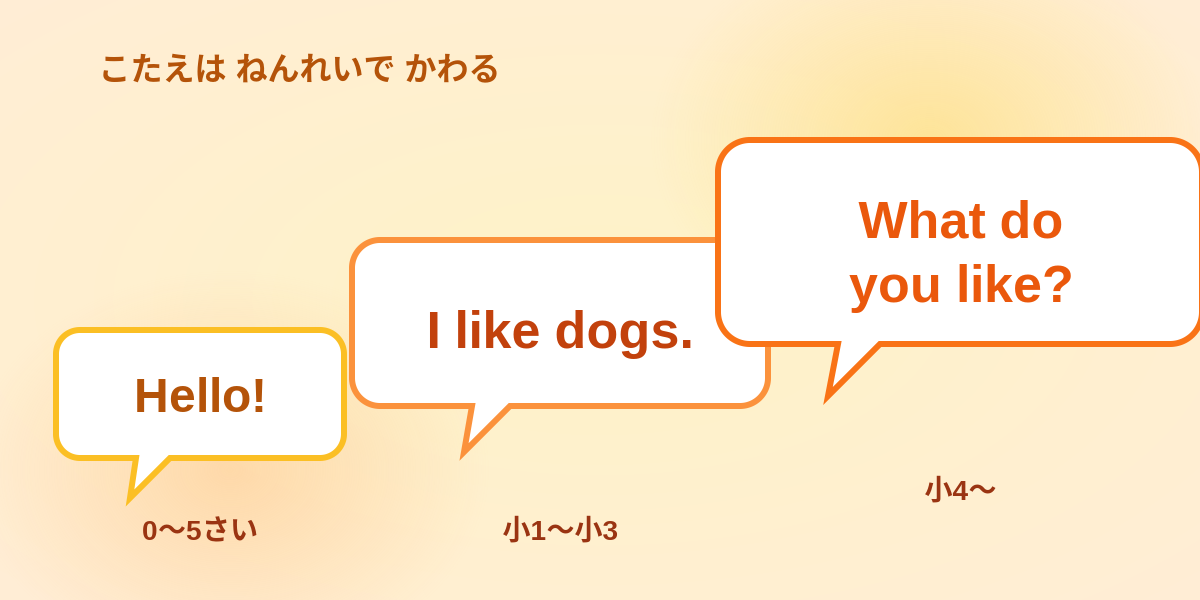
Short answer: “The earlier the better” is half right and half wrong. Hearing the sounds of a language favours the young; learning speed favours the older. So “what age” has no single answer: what to start differs by age, and that is the real answer.
| Age | Start this | Skip this |
|---|---|---|
| 0–3 | Songs, picture books and greetings in a parent’s voice. Exposure to the sounds | Apps, materials, anything that counts as “teaching” |
| 3–5 | English inside play: colours, animals, numbers, songs | Reading, writing, phonics, tests |
| Grades 1–3 | Time for real back-and-forth speaking (a class, an AI, an English speaker). Word cards | Grammar, long homework |
| Grade 4 up | Reading and writing, English for the child’s own interests, typing | Making it only “study” |
This post explains the table, how it fits Japan’s school English, why the home language comes first, why mixing Japanese is fine, and what to stop doing.
What “the earlier the better” gets right, and wrong
Right: sounds. Babies can tell apart the sounds of every language, and from around their first birthday the distinctions their home language does not use start to fade. English l and r, and th, stay available longer when a child hears a lot of them early. That part is true.
Wrong: speed. Given the same hundred hours, a 10-year-old learns faster than a 7-year-old. The reason is mundane: the older child already knows, in Japanese, how a language works. They can read, and they can handle an abstraction like “this is a verb”. So plenty of people start in upper elementary and become fluent.
Starting early, then, buys familiarity with the sounds, not earlier fluency. Many parents notice that a child who began lessons at three and one who began at five speak about the same amount in first grade. No need to rush; just let them hear the sounds early. That is the conclusion.
By age: what to start
0–3: a parent’s voice, and the sounds
No apps, no materials. A parent singing an English song, reading an English picture book, saying good morning. Pronunciation does not need to be good. The only goal at this age is for the body to learn that English sounds exist, and it does not take much: one song a day is plenty.
The priority at this age is the home language. Japanese vocabulary and back-and-forth conversation are the foundation English will later sit on. Don’t replace Japanese time with English time.
3–5: English inside play
Make English something that is simply present in play. Colours (what colour?), animals, numbers to ten, songs, the seasonal words of Halloween and New Year. Not making them learn words, but we were playing and it happened to be English.
No reading, writing, phonics or tests. Hiragana comes first. English letters can wait until grade 3.
Grades 1–3: make time for real back-and-forth
This is where homes differ most. Listen-only, watch-only English (videos, songs) stalls in elementary school at “I understand but I can’t say it”, because there is nobody to talk to.
So there is one job at this age: a few times a week, provide someone who speaks English to the child and waits for the answer. A class, an English-speaking friend, online lessons, an AI. Any will do. What matters is that there is a back-and-forth, and that mistakes are not corrected.
KidTalk was built for this. When the child speaks English, Poppy answers in English; Japanese gets Japanese. Mixing the two is fine. “I can’t say it in English so I’ll say it in Japanese” is the correct strategy for keeping a conversation going.
The English word cards are the vocabulary tool for this age: ten a day, turning words the child knows into words the child can say.
Grade 4 up: reading, writing and the child’s interests
From grade 4, Japanese reading and writing are stable enough for English letters to come in. English becomes a graded subject in grade 5, with reading and writing.
What works now is following the child’s own interests in English: dinosaurs, space, games, football. The child who reads English to learn about dinosaurs lasts far longer than the child who does English as “English study”. Once English typing lets them type their favourite words, they can search, and the world opens.
How it fits school English in Japan
- Grades 3–4: foreign-language activities (once a week, listening and speaking, no grades)
- Grades 5–6: English as a subject (twice a week, reading and writing, graded)
- Junior high: grammar and literacy in earnest
Grade 3 is designed to end at “speaking English is fun”. Whether a child enjoys it depends on being used to the sounds and able to say a little. Put the other way round, that is all a child needs before grade 3.
What to stop doing
- Replacing Japanese time with English time. The home language is the foundation. Thin it and both languages thin
- “Say it in English.” Switching to Japanese when a word is missing is the right move for keeping talk going. Mixing is fine
- Correcting pronunciation. Corrected children stop talking. With enough listening, pronunciation drifts into place on its own
- Reading, phonics and tests for preschoolers. Grade 3 is in time, and earlier does not stick
- Counting passive listening as “doing English”. Listening alone never becomes speaking. From first grade, a back-and-forth is needed
- Starting at a pace that cannot last. Ten minutes a day beats an hour a day that stops
FAQ
My child is in grade 4 and has done no English. Is it late? No, and in learning speed they are at an advantage. At grade 4 the child’s own interests are the best way in: watch an English video about what they love together, and turn the words that catch their ear into words they can say and type, with word cards and typing.
From what age does an English class pay off? A class with real back-and-forth pays off from around first grade. Preschool classes are fine as a place for songs and play, but differ little from what a home can do. The return is highest once the child is old enough to need someone to talk to.
I don’t speak English. You don’t need to. Songs at 0–3 need not be good, and from first grade the back-and-forth can come from someone other than a parent. A parent’s job is to keep English from being scary and to make a ten-minute slot every day.
From what age can a child talk to an AI in English? Asking questions in speech is possible from about three, but it starts working as English back-and-forth from around first grade, when the child has things to say. We wrote about a 3-year-old talking to an AI separately.
Summary
- “The earlier the better” is right about sounds and wrong about speed. The answer changes with age
- 0–3: sounds in a parent’s voice. Japanese comes first
- 3–5: English inside play. No reading or writing
- Grades 1–3: time for real back-and-forth. Mixing is fine, don’t correct
- Grade 4 up: reading, writing and the child’s interests. English becomes a tool
- School: activities from grade 3, a subject from grade 5. Before grade 3, “used to the sounds and able to say a little” is enough
Ready to try KidTalk?
Turn your child's curiosity into stories with safe, friendly AI.
Get started for freeRelated Articles

November 16, 2026
Addition and Subtraction: What Age? Within 10 at 5–6, Carrying in First Grade, and Why Counting on Fingers Is Fine

November 16, 2026
Kanji: what age? 80 in grade 1, reading before writing, and stroke order you trace rather than memorise

November 15, 2026