Hiragana: What Age? Reading at 4–5, Writing at 5–6, and Why Speaking Comes First
• KidTalk Team
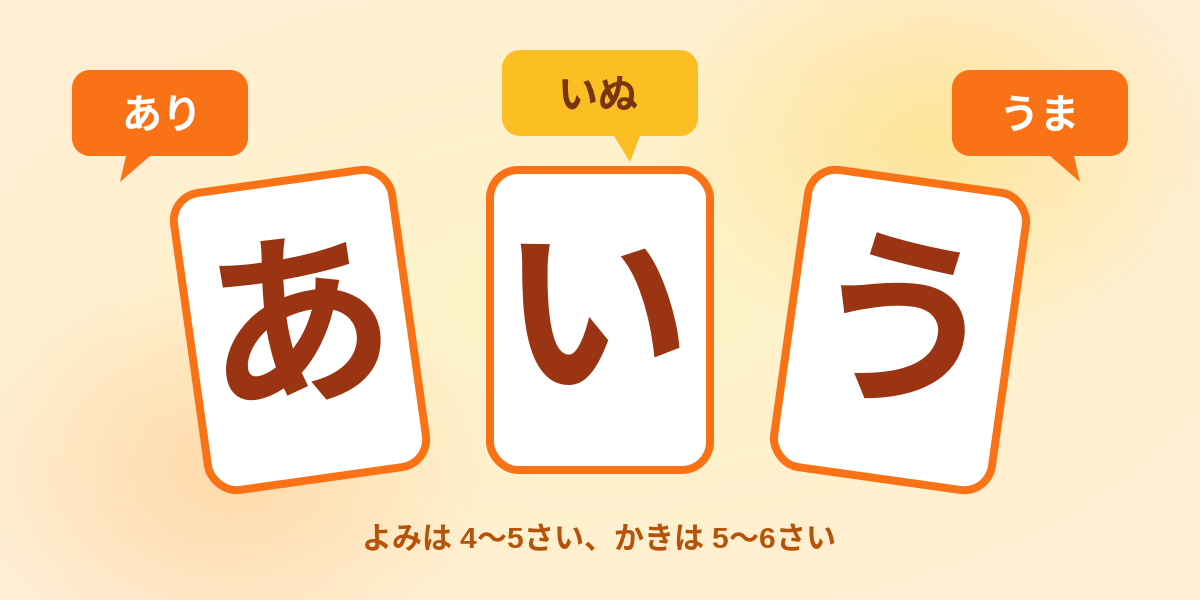
Short answer: Most Japanese children can read hiragana at 4–5 (the middle and top preschool years) and write it at 5–6. And one thing matters more than any milestone: Japanese first grade teaches hiragana from あ, from scratch, in the first term. It does not need to be perfect before school. Children who cannot read it yet, and children who write mirror-image letters, are perfectly normal at six. This post covers milestones by age, the reading-then-writing order, what works at home, what to skip, when katakana and kanji arrive, and the skill worth building before hiragana at all.
Milestones by age
Individual differences are large here, so these are ranges.
| Age | What children can do | What to do at home |
|---|---|---|
| 2–3 | Recognise the letters of their own name as shapes | Picture books, shiritori (it need not work yet) |
| 3–4 | Their name, あ, い, a few letters | Hunt for the letters of their name, the aiueo song |
| 4–5 | The number of readable letters jumps; letter-by-letter reading begins | Read picture books while tracing the text with a finger |
| 5–6 | Reads nearly all the basic letters; starts writing (mirror letters included) | Letters to grandparents, writing their name, tracing |
| First grade | All of hiragana in the first term, then voiced and contracted sounds, then katakana | Read aloud at the school’s pace |
“Can read” means recognising each letter on the chart, not reading sentences fluently. Moving from letter-by-letter reading (hi-ra-ga-na) to reading in chunks (hiragana as one word) takes well into first and second grade. That is normal.
Reading first, writing later
The order is always reading, then writing, for two reasons.
- Writing needs the hand. Holding a pencil properly and stopping or bending a line comes at around five. Before that, “my hand is tired” beats “this is the right shape”
- Writing turns sounds into letters. To write いぬ (inu, dog) a child must know that “inu” is made of two sounds, i and nu. That ability to split a word into sounds (phonological awareness) is the foundation of both reading and writing
The second reason is the point of this post.
The skill before hiragana: hearing the sounds
Pulling the final “go” out of “ringo”. Hearing that “kuma” and “kumo” start the same and differ in the second sound. With that skill, hiragana becomes “sounds I already know, with shapes attached”. Without it, hiragana is 46 pictures to memorise.
The games that build it use no letters at all.
- Shiritori, the word-chain game. It starts working at 4–5, and the “broken” version a 3-year-old plays has value too
- First-sound hunts: “What starts with a?” Ari, ame, ashi
- Clapping syllables: i-nu is two claps, zo-u-sa-n is four
- Riddles, which make a child search for a word by meaning
And vocabulary. The more words a child knows, the more sense reading makes, and the more fun it is. Vocabulary grows through back-and-forth conversation, not letters. Cut hiragana practice before you cut talking time.
At home: reading
- Start with their name. It is the word they most want to read. “It says Hana here, on your bag”
- Trace the text with a finger while reading picture books. Children notice that each letter is one sound. You first, then the child
- Letters in the street. Signs, snack packets, station names. “Look, there’s an あ.” This is the most effective hiragana practice there is
- Put up the chart, don’t drill it. It is not a tool for memorising but a place the child comes to ask “what does this say?”
- Stop when they stop. One letter a day is fine. Never say “one more”
At home: writing
- Tracing first. Pencils from around five; before that, big letters in crayon
- Don’t correct mirror letters. さ, ち and き flipped left to right are completely normal at 5–6 and sort themselves out during first grade. Correcting them teaches “writing is unpleasant” first
- Make a reason to write. A letter to Grandma, a New Year’s card, price tags for a pretend shop. One real letter beats one page of a workbook
- Stroke order after school teaches it. Before school, a recognisable shape is enough
A browser tool for hiragana and katakana
The “at home” part of this post, built: our free hiragana & katakana tool. Tap the chart and Poppy reads each character; “Read” shows a character and three pictures to pick from; “Listen” is karuta with Poppy calling; “Trace” follows the stroke order with a finger. It filters by row, so a day can be “just the ka row”. No login, and the record stays on the device.
What to skip
- Making them write everything before school. School spends a term on it. Arriving perfect just makes the term boring
- Daily drills. The cost of making a child dislike writing is too high
- Comparing with children who can read. Six months either way is normal here
- Rushing katakana and kanji. Katakana comes late in the first term or in the second, and the 80 first-grade kanji in the second half of the year. School covers both
Where screens help: typing, not tracing
There are many tablet apps for tracing letters, but paper does tracing fine. Screens become genuinely useful when a child types letters, from first or second grade. Romaji input is taught in third grade, but level 1 of our Japanese typing practice has children type ねこ (cat) and いぬ (dog) in kana, so a child who can read hiragana gets to check sound-to-letter from the other direction. It suits the stage where reading is there but handwriting is still slow.
FAQ
My child is in the last year of preschool and reads less than half the chart. Is that late? No. Many children jump in the second half of that year, and first grade teaches from scratch. If you are worried, add shiritori and picture books rather than letter practice.
My 3-year-old can read. Should I start writing? Let them read as much as they like, and wait on writing until the hand is ready. Big crayon あ is fine. Small, correct pencil letters can wait until five.
Hiragana or the English alphabet first? Hiragana. The home language’s script comes first. The alphabet arrives in third-grade foreign-language activities, but the sound-splitting skill is shared, so shiritori prepares for both. We wrote about English in “English: what age?”.
Won’t mirror letters become a habit if I leave them? No. Mirror writing is a stage where the shape is learned but the orientation is not yet needed. Once first grade brings volume, the orientation fixes itself.
Summary
- Reading at 4–5, writing at 5–6. First grade teaches from scratch in the first term
- Reading before writing. Writing needs the hand and the ability to split words into sounds
- Before hiragana, build sound-splitting and vocabulary with shiritori, riddles and conversation
- Street letters and the child’s own name work best. Leave mirror letters alone
- Don’t aim for perfect before school. Katakana and kanji can wait for school
Ready to try KidTalk?
Turn your child's curiosity into stories with safe, friendly AI.
Get started for freeRelated Articles

November 16, 2026
Addition and Subtraction: What Age? Within 10 at 5–6, Carrying in First Grade, and Why Counting on Fingers Is Fine

November 16, 2026
Kanji: what age? 80 in grade 1, reading before writing, and stroke order you trace rather than memorise

November 15, 2026