Choosing an English App for Your Child: 3 Types, 4 Tests
• KidTalk Team
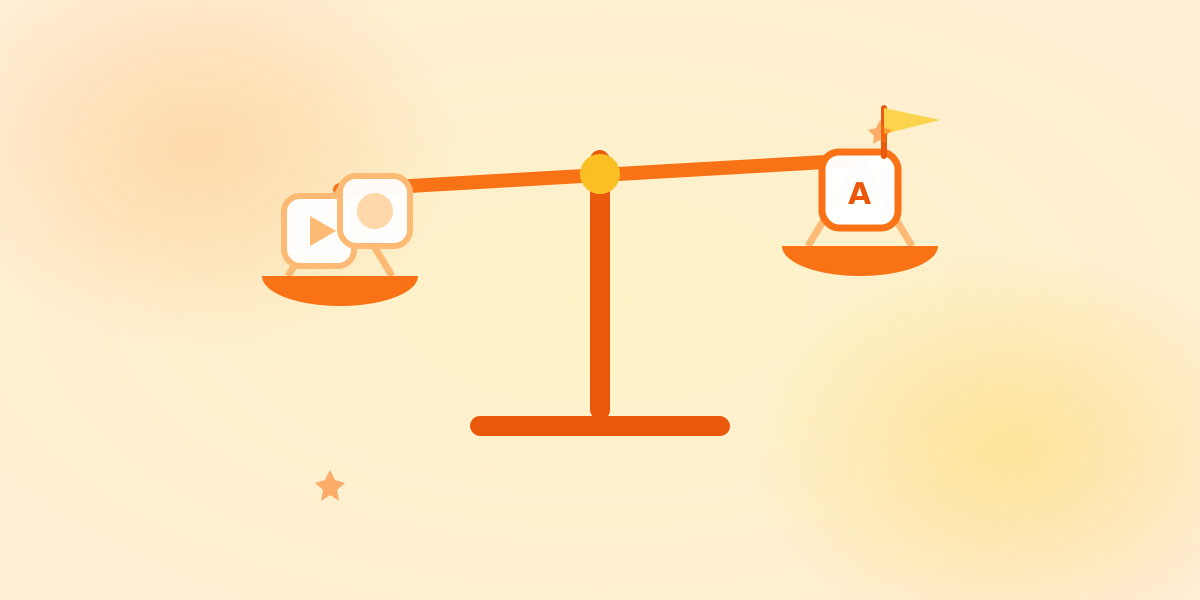
Short answer: Children’s English apps come in three types — ① media-based learning (videos, songs, games), ② online lessons with a human teacher, and ③ AI conversation — and they build different skills: input, real human practice, and daily mouth-time respectively. A price-column comparison can’t choose between them because they’re not doing the same job. Apply four tests instead: how many minutes the child’s mouth actually moves, how many days a week it realistically happens, whether the child can run it alone, and whether you can see what’s going on. And honestly? For most families the best answer isn’t one app — it’s an inexpensive combination.
In our home-study guide we made the case that what school English lacks is output — speaking time per child. This is the sequel: so which app do we actually install?
Sort before you compare
| ① Media-based | ② Online lessons | ③ AI conversation | |
|---|---|---|---|
| The child… | watches, listens, taps | talks with a teacher on screen | talks with an AI by voice |
| Builds | vocabulary, ear, familiarity | courage and experience with people | daily speaking volume |
| Speaking time | near zero | high (if one-to-one) | every session |
| Realistic frequency | daily | 1–3×/week | daily |
| Cost range | free–¥2,000/mo | ¥3,000–7,000/mo | ¥600–1,000/mo |
| Runs without a parent? | yes | needs booking + supervision | yes |
① Media-based — the best front door, and a door that never asks you to speak
Songs, phonics videos, word games: nothing introduces English as fun better, and the price of entry is near zero. The limit is structural: the screen never waits for your child’s reply. It’s the same passive-media mechanics as any video — years of it lands at “understands some, says nothing.”
② Online lessons — the real thing, rationed by the calendar
A real teacher who asks again, praises, and visibly understands — nothing else on this list substitutes for practice with an actual person. Two practical walls: frequency (booked lessons run 1–3×/week, and daily-short beats weekly-long for language), and logistics — for younger children, booking, connecting and supervising is a recurring parent job.
③ AI conversation — the daily reps, not the match
KidTalk lives here, so read this row knowing that.
The type’s virtue is frequency without friction: no booking, no waiting audience, no embarrassment, a few spoken minutes every day. Since language grows on turns, a structure where speaking happens every single session earns its place. KidTalk specifically switches language per utterance — a child can try just the words they know in English and fall back mid-sentence, which is the lowest possible on-ramp.
What it isn’t: a substitute for talking to people. The pauses, the re-asks, the face that lights up when you’re understood — that’s type ②’s job, and daily life’s. There’s no curriculum and no test prep either.
The four tests
Before the price column, ask:
- Minutes of mouth movement. Not “exposure time” — time the child produces English sounds. Media-based scores near zero; group lessons divide by headcount.
- Days per week, realistically. A so-so tool used daily beats an ideal tool used weekly. Picture your actual week.
- Can the child run it alone? Anything needing a parent every session stops during your busy weeks — and restarting a stopped habit is the hardest part.
- Can you see what’s happening? If you can’t tell what they talked about or what’s improving, you can’t decide to continue or to quit.
The honest conclusion: combine
No single app covers all three jobs. The combination that works in practice:
- Foundation: school + media-based input (free–cheap)
- Daily: AI conversation, a few minutes of reps
- Weekly: an online lesson with a human, if the budget allows
All three together stay under ¥10,000/month — and the cheapest layer, the daily one, does the most work by frequency. On a tight budget, keep the highest-frequency layer and cut from the top.
Frequently asked questions
Is an AI conversation app safe for this? Judged the same way as any kids’ AI — visibility, caps, no ads, no training on the child’s voice. The safe-apps comparison covers the category in depth.
From what age? Media-based: often 2–3. AI conversation: once a child can ask a question by voice, around 3–4. Online lessons: once they can sit with an on-screen teacher for thirty seconds — enormously variable.
Why no named-app comparison? Two reasons. Named comparisons go stale in months as prices and features shift. And we’re a participant in type ③ — our ratings of competitors would deserve your skepticism. The type-sorting and the four tests are the durable tools; with them you can evaluate any app on the shelf yourself.
My child quits everything. Which type sticks? Session length predicts survival better than type. Under five minutes with a clear ending sticks; a 30-minute lesson is a wall for younger kids regardless of quality.
Will an app fix pronunciation? A clear daily model helps, but pronunciation grows from many inputs — and at this age the real goal is willingness to open the mouth, which correction kills faster than anything.
In summary
- Three types building three skills — never compare them in one column
- Media = input · human lessons = the real thing · AI = daily reps
- Four tests: mouth-minutes, weekly frequency, runs-alone, parent visibility
- The best answer is usually a combination — and the cheapest layer works hardest
When in doubt, return to the one question that settles it: “Will this make my child’s mouth move?”
Ready to try KidTalk?
Turn your child's curiosity into stories with safe, friendly AI.
Get started for free