YouTube vs. Talking: Why "Screen Time" Is the Wrong Unit
• KidTalk Team
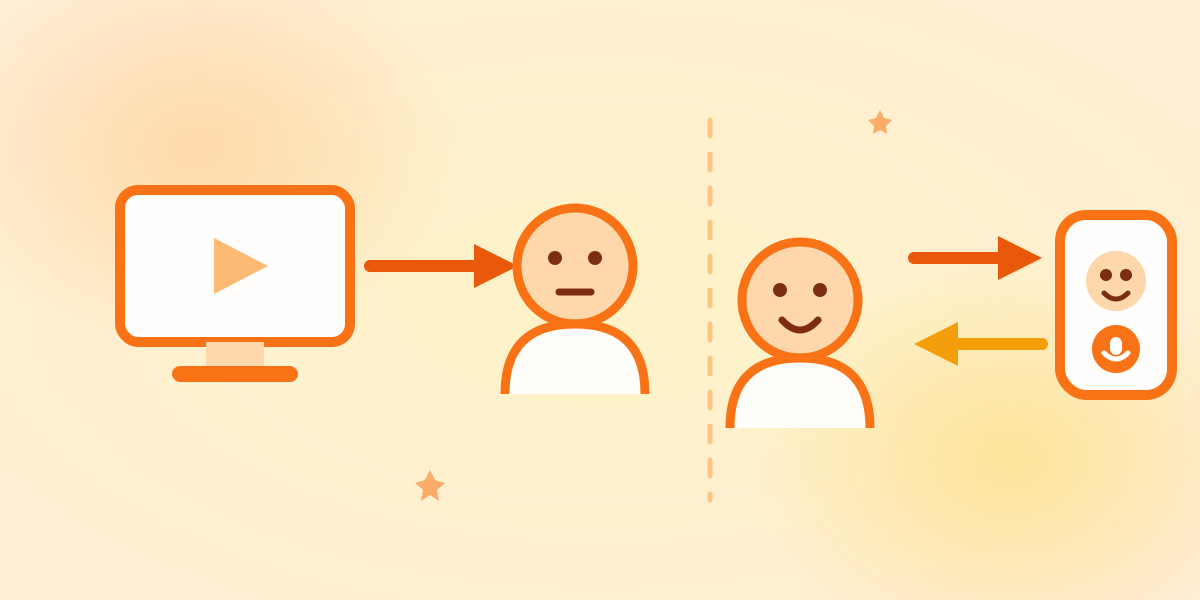
Short answer: Counting minutes tells you almost nothing, because it treats a forty-minute autoplay chain and a five-minute conversation as the same substance. The distinction that matters is whether the screen waits for your child. A screen that never waits produces no turns, and turns are what build language. This isn’t an argument for banning video — it’s an argument for a better question than “how long?”
Every parent has heard the guidance, and most feel vaguely guilty about it. Two hours. One hour. None before two.
The trouble is that “screen time” is a container, not a content. Measuring it is like measuring “food time” — technically possible, and it tells you nothing about whether the child ate an apple or a bag of sweets.
The distinction that actually matters
Ask one question about any screen your child is using:
Does it wait?
That’s it. Everything else follows.
| Passive | Active | |
|---|---|---|
| What it does | Plays regardless of the child | Stops until the child responds |
| Child’s role | Receives | Produces |
| Turns generated | None | One per exchange |
| When it ends | When someone intervenes | When the child stops |
| Examples | Autoplay video, background TV | Conversation, video calls, co-watching with talk |
Video doesn’t wait. That is not a moral failing of video — it’s the design. A programme cannot pause while a four-year-old decides what they think, so it doesn’t. It carries on, and the child receives.
Why “receiving” doesn’t build language
We wrote about this at length in It’s the turns, not the words, and this is the practical consequence.
Research on early language has consistently found that what tracks children’s language development is the number of back-and-forth conversational turns, more than the sheer volume of words in the room. When a child has to reply, four things happen: they must understand, convert a thought into words, anticipate a reaction, and rephrase if it doesn’t land.
A screen that never waits triggers none of the four. Which is why children can absorb enormous quantities of video and gain much less language from it than an equivalent stretch of conversation — a pattern researchers have noted for years, and which surprises parents every time.
The screen is not the problem. The absence of a turn is.
But YouTube isn’t the enemy
We’re not going to pretend otherwise, and a piece that did would be dishonest.
Video does things conversation can’t. A child can watch a volcano erupt, a cheetah run, a seed germinate over three weeks in ten seconds. That imagery is genuinely valuable and no amount of talking replicates it.
The realistic position isn’t elimination. It’s balance, plus one intervention.
The intervention: talk during it
Watching with your child and talking changes the value of the same footage entirely.
- “Why do you think it does that?”
- “What’s going to happen next?”
- “Would you want to go there?”
The video hasn’t changed. You’ve added the turns it couldn’t provide. This is by some distance the highest-value screen-time habit available, and it costs nothing.
A practical sorting
Rather than a minutes budget, try sorting the day’s screen use into three buckets.
1. Filling time — autoplay, background, the tablet handed over to buy twenty minutes. Legitimate and sometimes necessary. Worth noticing, because it’s the bucket that silently expands.
2. Watching something specific — a chosen programme, a film, a documentary about sharks. Real value, especially with a conversation afterwards.
3. Producing something — drawing, building, video-calling grandparents, talking. This is the bucket where the child is the active party.
You don’t need a rule. You need to know roughly what the split looks like, because most families are surprised by the answer, and noticing tends to be enough.
Where a talking app sits
Straightforwardly: KidTalk is in bucket three. It’s a screen, and it counts as screen time on any tally — but it belongs on the side that waits.
- It stops. Nothing happens until your child speaks. The pause can be as long as they need.
- Every use is a turn. Speak, get a reply, speak again. Structurally back-and-forth, not one-directional.
- There’s no autoplay. Nothing queues the next thing. Nothing is engineered to keep a child there.
- There’s a daily limit. Deliberately. An app for children with no ceiling is designed against the family’s interests.
That last point is where the comparison gets sharp. Video platforms are optimised for watch time; we cap usage on purpose. Those are opposite business incentives, and it’s worth knowing which one any app you install is running on.
And the honest caveat, as always: talking to an AI is not talking to a person, and it doesn’t replace conversation with family. See our position on that.
Frequently asked questions
So how many minutes is okay? There’s no number that survives contact with real life, because it depends entirely on what’s in the minutes. Rather than a budget, ask: did the screen wait for my child at any point today? If never, that’s the thing worth changing — not the total.
Is educational YouTube different from entertainment YouTube? Better content, same structure. Content quality matters, but it doesn’t create turns. An educational video watched in silence is still one-directional; an entertainment video watched together and talked about generates plenty.
My child gets furious when I turn it off. Is that a bad sign? It’s a common one. Autoplay removes natural stopping points, so every stop is imposed from outside. Warning in advance (“two more, then we’re done”) and stopping at an ending rather than mid-item both help a lot.
Isn’t a talking app just more screen time? It is screen time. We’d rather be honest about that than play word games. The argument isn’t that it doesn’t count — it’s that what happens inside the minutes differs, and an app that stops and waits is on the other side of the line from one that plays on regardless.
What about very young children — under two? Guidance from major health bodies is consistently cautious about screen media below about eighteen months to two years, with video calls to family generally treated as the exception. And that exception is instructive: the video call is the one that waits.
In summary
“How long?” is the wrong question. “Did it wait?” is the right one.
- Passive media generates no turns; turns are what build language
- Video is genuinely valuable — it just can’t do that job
- Talking during it converts passive to active for free
- Sort the day into filling / watching / producing, and simply notice the split
- Watch out for anything optimised to maximise time spent
You don’t need to ban screens. You need to make sure something in your child’s day stops and waits for them to speak.
Ready to try KidTalk?
Turn your child's curiosity into stories with safe, friendly AI.
Get started for free