Nengajo (Japanese New Year Cards) With Kids: What Age, What to Expect at Each Age, and the 2027 Dates
• KidTalk Team
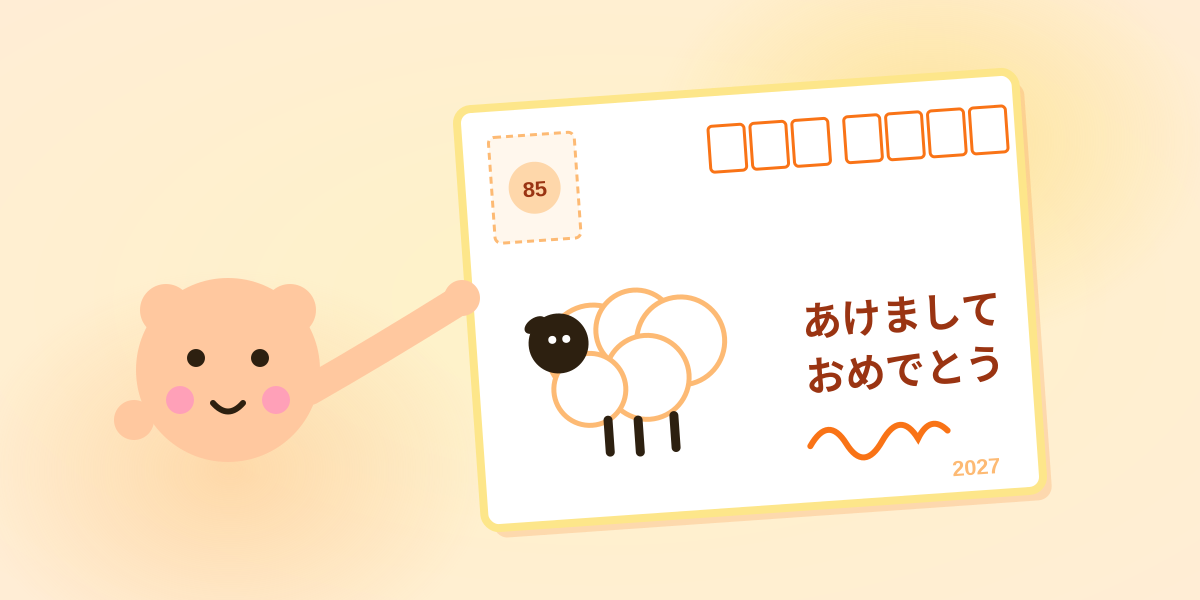
Short answer: A child’s nengajo (New Year postcard) grows with the child. At 3–4, a handprint or stamp and a scribbled name. At 5–6, their own name and 「あけましておめでとう」 in hiragana. In grades 1–2, the address on the front. From grade 3, a one-line message written for the person who will read it. Nothing has to be neat, and three to five cards is plenty. For 2027, Japan Post accepts nengajo from Sunday 20 December; mail by Sunday 27 December for delivery on New Year’s Day; a plain card costs ¥85. This post covers what to expect at each age, what to skip, why the address is a sneaky geography lesson, the English line for friends overseas, and the typing project for third-graders.
Why a paper card, in the age of LINE
Adults send fewer nengajo every year. The reason to keep the custom alive for a child is that a nengajo is the first letter they write for a real reader.
- Someone is on the other end. Hiragana practice at kindergarten is written for the teacher to check. A nengajo is read by Grandma. Writing changes when the child knows who will read it.
- A reply comes back. In January, a postcard arrives with the child’s own name on it. Once a year, letters become something that travels.
- It gives hiragana a job. A child who has just learnt hiragana is looking for somewhere to use it. The nengajo is the first real task.
Keep the list short: grandparents and one or two friends. For a child, the point is the writing, not the mailing.
By age: what “enough” looks like
Ages 3–4: a handprint and a scribble
Ask for: a handprint or stamps, a drawing in any colour. A parent writes the name; the child adds a scribbled “signature” next to it. Do not ask for: letters, straight lines, a tidy result.
At this age the card is a piece of art. Grandparents compare the handprint with last year’s. Use a washable, child-safe ink pad.
Ages 5–6: their own name and the greeting
Ask for: the child’s name in hiragana and 「あけましておめでとう」 (akemashite omedetou, “Happy New Year”). Do not ask for: the address, kanji, a long message.
The greeting is eleven characters, which is long for a five-year-old. Pencil it in lightly for the child to trace, or split it: the child writes あけまして and a parent writes おめでとう. The name is the child’s own work. Mirror-image letters and characters that spill out of the line stay as they are; that is what this year’s card looks like.
Grades 1–2: the address, in the child’s hand
Ask for: the recipient’s address and name, and the seven-digit postal code. Do not ask for: a long message on the back, every kanji in the address.
In first grade the front of the card is the main event. Writing the address turns “Grandma lives in Hokkaido” from a word into a place with a prefecture, a city and a street number. Japanese schools teach the 47 prefectures in grade 4; a child who writes nengajo addresses has written their own family’s prefectures by hand three years earlier. Before writing, light up Grandma’s prefecture in the prefecture quiz so the address attaches to a spot on the map.
Many address kanji (神奈川県, 札幌市) are beyond a first-grader. A parent pencils them in and the child traces. The seven digits of the postal code are a good length for writing numbers in boxes.
Grade 3 and up: a line written for the reader
Ask for: one sentence addressed to this particular person (“I’ll visit again in summer”, “I got better at soccer”). Do not ask for: memorised set phrases.
By third grade a child can change what they write depending on who will read it, which is the beginning of real composition and the part adults struggle with most. The four-kanji greeting 謹賀新年 is beyond the grade-3 kanji list, but copying it from a model is a satisfying exercise.
What to skip
- Making every card neat. A nengajo is not homework. If the fifth card is messier than the first, the person who receives it will be just as pleased.
- Sending many. Three to five cards, to the people the child actually wants to write to.
- Kanji. Address and greeting can be all hiragana. ほっかいどう さっぽろし is delivered without trouble.
- Finishing perfectly in December. The target is 27 December, but a card that slips past 7 January can simply be sent as a 寒中見舞い (mid-winter greeting) instead.
Dates and prices for 2027
| 2027 cards | |
|---|---|
| Cards on sale | 2 Nov 2026 – 15 Jan 2027 |
| Post office starts accepting nengajo | Sun 20 Dec 2026 |
| Mail by, for New Year’s Day delivery | Sun 27 Dec 2026 |
| Price | ¥85 for a plain or inkjet card (¥90 for the charity picture card) |
| Zodiac animal | Sheep (未, hitsuji) |
The acceptance date moved from 15 December to 20 December this year. A card dropped in the box on or before 19 December is handled as ordinary mail and arrives before the year ends, so finished cards wait at home until the 20th. Showing the child “the 20th” on a calendar is a small calendar-reading lesson in itself.
A sheep is an easy animal for a child to draw: a fluffy cloud, a face, four legs. “How many sheep?” turns it into counting.
The English line for friends abroad
For a friend or relative overseas, Happy New Year! is the whole message. As the New Year English post explains, the phrase is fine before the year turns, so it sits naturally on a card written in December. Add one more line if you like: See you in summer!
Writing the alphabet is realistic from grade 3 (capitals) and grade 4 (lower case). Younger children write their name in hiragana under the English a parent wrote. That counts as an English nengajo.
From grade 3: the address list as a typing project
Third-graders learn romaji and start typing. The nengajo address list is a real task of exactly the right size.
- A parent writes the five names and addresses on paper.
- The child types them into a spreadsheet or notes app, converting hiragana to kanji, which is the whole of Japanese input in miniature.
- Next year, open the list and add one entry.
Addresses contain place names (神奈川, 埼玉) that never appear in a child’s everyday writing, so seeing the kanji appear on conversion is a quiet preview of the prefecture kanji taught in grade 4. The keyboard itself can be practised on short words at the typing page.
Talk first, then write
A child who is stuck on the back of the card usually can write; what they lack is a sentence to write. Put a few minutes of talking before the pencil. “What is the one thing you want to tell Grandma this year?” “What was the best part of the summer visit?” Whatever the child says becomes the line on the card. A parent is the best listener for this, but in a busy December the child can also talk it through with Poppy in KidTalk and bring the sentence back to the table. The card is the deadline that turns talk into writing.
FAQ
From what age can a card go out in the child’s own name? Any age. A three-year-old’s handprint card arrives fine with the parent’s name added to the sender line. A card with only the child’s name feels natural from around 5–6, when they can write it themselves.
Isn’t messy writing rude to the recipient? Almost nobody receiving a card from a child minds the shape of the letters; the point is that this year’s letters are on it. The same goes for a card to a teacher.
We missed 27 December. Cards posted from 28 December may not arrive on New Year’s Day. If it will arrive by 7 January, send it as a nengajo; after that, the same card works as a mid-winter greeting. For the child, “late but sent” is the lesson that matters.
How many cards? Three to five. Each is handwritten, so a longer list becomes the parent’s job. Keep it to the people the child named.
Summary
- Ages 3–4: handprint and scribble. Ages 5–6: name and greeting in hiragana. Grades 1–2: the address. Grade 3 and up: one line for the reader.
- 2027: accepted from 20 December, mail by 27 December, ¥85 a card. Finished cards wait until the 20th.
- Skip neatness, quantity, kanji and perfection.
- The address is a three-year head start on the grade-4 prefectures.
- Happy New Year! is enough for friends abroad; from grade 3, type the address list.
Related: Winter break home learning, Hiragana: what age, Prefectures: what age, New Year English at home
Ready to try KidTalk?
Turn your child's curiosity into stories with safe, friendly AI.
Get started for freeRelated Articles

November 16, 2026
Addition and Subtraction: What Age? Within 10 at 5–6, Carrying in First Grade, and Why Counting on Fingers Is Fine

November 16, 2026
Kanji: what age? 80 in grade 1, reading before writing, and stroke order you trace rather than memorise

November 15, 2026