Japan's 47 Prefectures: What Age Children Learn Them, the Step After Flags, and How to Practise at Home (Free Prefecture Quiz)
• KidTalk Team
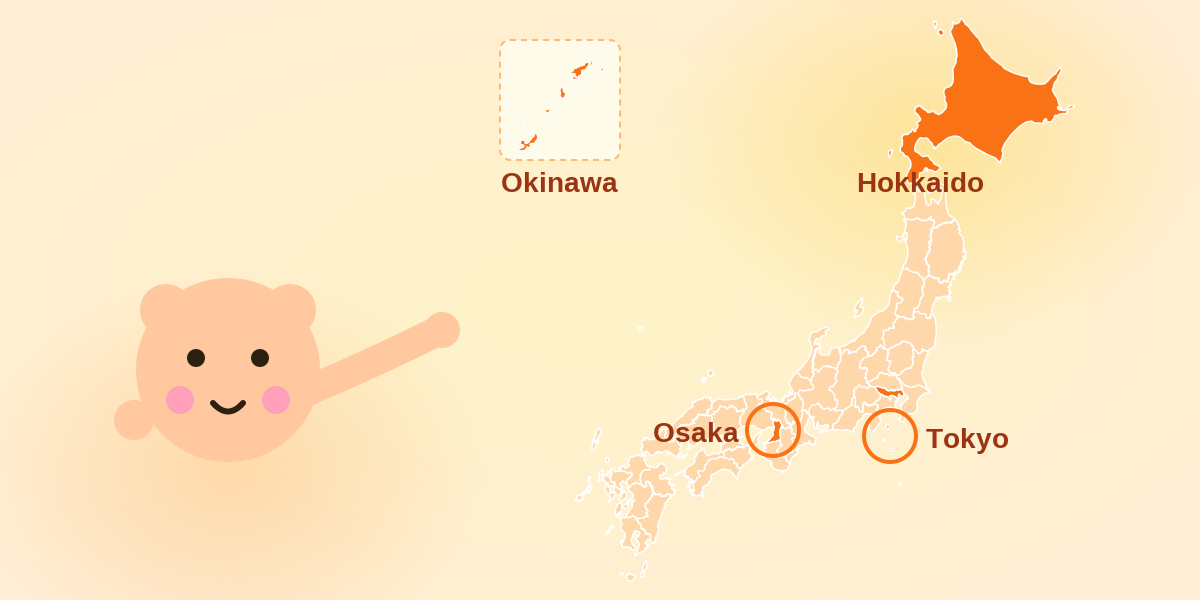
Short answer: At 3–4 a child knows their own prefecture and Grandma’s; at 5–6 the ones with a clear shape, like Hokkaido and Okinawa, and the eight regions they group into; and in grade 4, school teaches all 47 by name and position. There is no need to learn them all early, but for a child who loves flags the prefectures are the natural next collection, and the New Year trip to the grandparents is the best classroom of the year. This post covers the order by age, what school actually tests (the 18 capitals, the 20 kanji), how to practise at home, the English names, and the prefecture quiz we built.
Why prefectures come after flags
The flags post argued that flags suit children because they are made of colour and shape, come in a finite set, and adults do not know them. Prefectures share all three.
- Shapes to recognise. Hokkaido, Okinawa, Chiba, Niigata, Nagano. A map outline needs no reading.
- Forty-seven and done. Not a whole atlas; one page. “I know them all” is a realistic goal.
- They connect to the child. The prefecture they live in, were born in, where Grandma lives, where the family went on holiday. The child’s own experience lands on the map before any fact does.
The difference from flags is that the point of a prefecture is its position. A child who knows the names but not where they are gets nothing out of grade-4 social studies.
The order children actually follow
Ages 3–4: my prefecture and Grandma’s
Ask for: “I live in Kanagawa”, “Grandma is in Hokkaido”. Do not ask for: positions on a map, the 47 names.
Place names should come up in conversation before anyone opens a map. “Grandma’s house is far, it’s in Hokkaido, so we fly.” When a name attaches to something concrete, far or near, cold or hot, by the sea, it sticks the moment it later meets the map.
Ages 5–6: the prefectures with a shape, and the regions
Map puzzles get interesting now. Hokkaido, Okinawa, Kagoshima, Chiba, Niigata, Nagano, Iwate: start with the shapes a child can recognise. At the same time the regions begin to mean something: “Tohoku is cold”, “Kyushu is where Uncle lives”. There are eight (Hokkaido, Tohoku, Kanto, Chubu, Kinki, Chugoku, Shikoku, Kyushu-Okinawa), and sorting 47 into eight boxes first is a method that still works in grade 4.
The one thing for parents to do at this age: put a map on the wall. The bathroom, the toilet, anywhere it is seen daily. Whether there is a map in the house changes how grade 4 begins.
Grade 4: all 47 by name and position
The national curriculum places “the names and positions of the 47 prefectures” in grade-4 social studies. Since the 2020 curriculum, the 20 kanji used only in prefecture names (阪・媛・岡・熊・鹿・栃・奈・梨・阜・埼・茨・滋・賀・潟・縄・井・沖・佐・崎・香) are also assigned to grade 4, so a fourth-grader is expected to write 大阪, 愛媛 and 岐阜.
The other thing school tests is the prefectural capital. Most share the prefecture’s name, but 18 do not:
| Prefecture | Capital |
|---|---|
| Hokkaido | Sapporo |
| Iwate | Morioka |
| Miyagi | Sendai |
| Ibaraki | Mito |
| Tochigi | Utsunomiya |
| Gunma | Maebashi |
| Saitama | Saitama City |
| Kanagawa | Yokohama |
| Ishikawa | Kanazawa |
| Yamanashi | Kofu |
| Aichi | Nagoya |
| Mie | Tsu |
| Shiga | Otsu |
| Hyogo | Kobe |
| Shimane | Matsue |
| Ehime | Matsuyama |
| Kagawa | Takamatsu |
| Okinawa | Naha |
These 18 are the classic test items. Put the other way round, only these 18 need learning; the rest match the prefecture, and a child who hears “just eighteen” relaxes.
Grades 5–6: from the map to industry and history
Grade-5 social studies is farming, industry and fishing, staged on the prefectures: Niigata rice, Aichi cars, Shizuoka tea. Grade 6 is history: the capital at Nara, the shogunate at Kamakura, Dejima in Nagasaki. A child who has the positions from grade 4 experiences grades 5 and 6 as stories on a map they already know. That is the reason to settle the prefectures in grade 4.
Practising at home
- In the car or train to the grandparents’. “Which prefecture are we in?” “Which is next?” “Which region is Grandma’s house?” Give the child the map app and have them call out each border; the round trip teaches ten prefectures.
- The weather forecast. A free prefecture lesson every evening. Ask one question: “Where is coldest tomorrow?”
- Where food comes from. The milk carton, the mandarin box, the rice bag. “Where is this from?” works like showing a real flag.
- Play with the shapes. “Which prefecture looks like a bird?” (Chiba, or Kagoshima.) Digressions like this are what memory is made of.
- Chant only the 18. Say aloud only the capitals that differ, the way children chant the times tables. The mouth remembers.
What to skip: reciting all 47 from north to south. The order does nothing for positions. By region (eight boxes), shapes first, the child’s own prefectures first: that is the order.
The English names, aloud
The same idea as “English country names alongside the flags” in the flags post. In English the prefectures are Hokkaido, Tokyo, Osaka, Okinawa, essentially their romaji. For a child in grades 3–4 learning romaji, prefecture names are the most familiar real text they can already read. Kyoto, Hiroshima and Nagasaki are words people abroad know, which makes them a child’s first “Japanese place names I can say in English”, ready to show the grandparents over winter break.
The word is prefecture. Japanese distinguishes 都 (Tokyo), 道 (Hokkaido), 府 (Osaka, Kyoto) and 県 (the other 43); English uses prefecture for all of them (Tokyo is sometimes rendered Tokyo Metropolis). One word is enough for an elementary child.
The prefecture quiz we built
We added a prefecture quiz to Play & Learn. It is built like the flag quiz: one prefecture lights up orange on a map of Japan, and the child says where it is.
- Flip: tap the highlighted prefecture to see its name in kana, kanji and English, each read aloud by Poppy. Japanese in the Japanese voice, English in the English voice.
- Map → name: pick the highlighted prefecture’s name from three cards.
- Name → map: Poppy says a name, three prefectures on the map get the badges ①②③, and the child picks the right number.
- Capital: a prefecture lights up and the child picks its capital from three cards. This is where the 18 get practised.
- Shape: no map. The prefecture’s outline alone fills the screen and the child picks the name from three cards. No neighbours, no region hint: the hardest mode. The map lights up once the answer is found.
There are no difficulty levels, only a filter for the eight regions: we did not want to sort children’s home prefectures into “well-known” and “the rest”. A miss says “close, try again!” and the question stays; ten questions earn stars. Because it works in kana, children younger than grade 4 can use it as a map puzzle, and the English read-aloud leads into the written English of grade 5. Free, no login, records stay on the device.
FAQ
Should my child learn all 47 before grade 4? No. School teaches them in grade 4. Before that, aim for the child’s own prefectures, the ones with a clear shape, and the eight regions. With those three in place, grade 4 goes smoothly.
How far with the capitals? The 18 that differ from the prefecture name. Those are also what junior-high entrance exams mostly ask.
My child cannot remember positions. That happens when name and position are learnt separately. Cut the map into regions and the candidates drop to one eighth. The region filter in the quiz exists for this.
Are the English names necessary? Not necessary; they just pair well with romaji practice. Once “Hokkaido” is readable, romaji turns from schoolwork into something used.
Summary
- Ages 3–4: my prefecture and Grandma’s. Ages 5–6: shapes and the eight regions. Grade 4: school teaches all 47 by name and position.
- School tests the 18 capitals that differ and the 20 prefecture kanji (grade 4).
- At home: the trip to the grandparents’, the weather forecast, where food comes from. No north-to-south recitation.
- The English names are the romaji; a grade 3–4 child’s most familiar real reading material.
- The prefecture quiz: flip, map → name, name → map, capital, shape. Free, no login.
Related: Flags of the world: what age, Typing: what age, Winter break home learning
Ready to try KidTalk?
Turn your child's curiosity into stories with safe, friendly AI.
Get started for freeRelated Articles

November 16, 2026
Addition and Subtraction: What Age? Within 10 at 5–6, Carrying in First Grade, and Why Counting on Fingers Is Fine

November 16, 2026
Kanji: what age? 80 in grade 1, reading before writing, and stroke order you trace rather than memorise

November 15, 2026