Times Tables (Kuku): What Age, the Order Japanese Schools Teach Them, and How to Practise at Home (Free Practice Tool)
• KidTalk Team
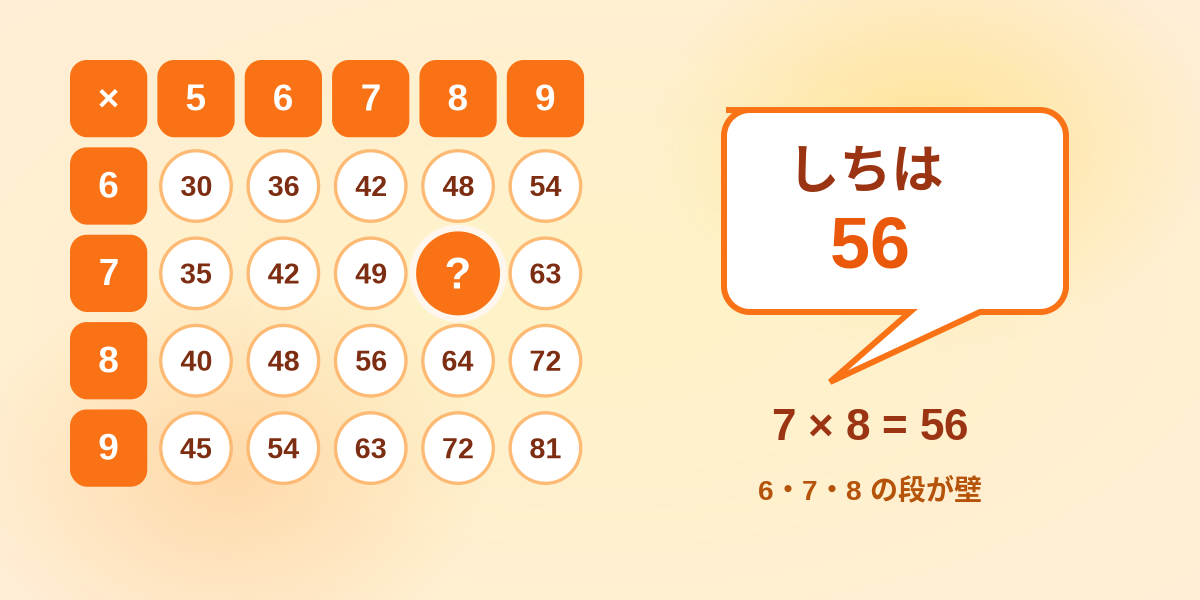
Short answer: In Japan, the times tables (kuku, 九九) are taught in the second term of second grade, roughly October to December, when children are 7–8. If you want to start earlier at home, the 5s and the 2s at age 5–6 are plenty; there is no need to push the rest. What matters more is that the child understands what multiplication counts before memorising it, and that someone at home can spare three minutes a day while they cross the 6s, 7s and 8s. This post covers the textbook order, where children get stuck and why, the chanted readings, the three stages of mastery, home habits, and the free kuku practice tool we built.
Less “what age” than “what order”
Kuku is memorisation, but one piece of understanding has to come first: 3 × 4 means “three, four times”. Without that, a child is memorising 81 spells, and a forgotten spell is gone. With it, a forgotten 7 × 8 can be rebuilt from 7 × 7 = 49 plus 7.
So if you start early, start with the meaning rather than the chant: lay out sweets or counters “3 on each of 4 plates” and count 12. That is exactly what the first term of second grade does at school.
A 5- or 6-year-old who can count in fives (5, 10, 15 …) or twos (2, 4, 6 …) will take the 5s and 2s easily. Everything beyond that can wait for school, where you do it together.
The textbook order, and why
Most Japanese textbooks go 5 → 2 → 3 → 4 → 6 → 7 → 8 → 9 → 1. The 1s come last because “one, three times” only makes sense after the idea of multiplication is in place. The 5s and 2s come first because children already skip-count in them.
The order is also the order of difficulty.
| Table | Difficulty | Why |
|---|---|---|
| 5s, 2s | easy | skip-counting |
| 3s, 4s | normal | learning the chanted readings |
| 6s, 7s, 8s | hard | big answers that look alike (42, 48, 54, 56, 63) |
| 9s | surprisingly easy | the digits of every answer add up to 9 |
| 1s | easy | obvious once the meaning is understood |
Almost every child hits the wall at the 6s, 7s and 8s. Within those, 7 × 8 = 56, 6 × 8 = 48, 4 × 7 = 28 and 6 × 7 = 42 are the facts some adults still pause on. The reasons are mundane: the answers resemble each other, the chants have poor rhythm, and none of them come up in daily life. This is the one place where repetition is everything.
Use the school’s readings
Kuku is learned by sound, so match the readings the school uses. A child taught “san kakeru san wa kyū” at home and “sazan ga ku” at school has two chants to keep straight.
- 3 × 3 = 9 is sazan ga ku
- 2 × 2 = 4 is ninin ga shi
- 5 × 9 = 45 is gokku shijūgo
- 8 × 8 = 64 is happa rokujūshi
- 4 × 7 = 28 is shishichi nijūhachi
- 7 × 7 = 49 is shichishichi shijūku
When the answer has one digit the chant inserts “ga” (san ichi ga san); with two digits it does not (san shi jūni). That little “ga” is how the body learns how many digits to expect.
The three stages: ascending, descending, random
Japanese schools pass children through three stages per table. Do the same at home.
- Ascending (agari kuku): chant from × 1 to × 9 in order. This is a song, and everyone learns songs
- Descending (sagari kuku): from × 9 down to × 1. The momentum of the song is gone, and each fact has to be recalled on its own. This is the first honest test of memory
- Random (bara kuku): facts asked in any order. This is the real thing, and what school tests
It is tempting to call a table “learned” after the ascending chant, but until random works it is half learned. A child who answers “7 × 8?” by starting the chant from “shichi ichi ga shichi …” is still at the song stage.
At home
- Three minutes, same time every day. In the bath, before bed, before breakfast. Daily beats long
- One table at a time. Two or three days per new table: ascending, descending, random. Review earlier tables once a day
- Chant together with the “ga” rhythm. You first, the child echoes. Showing the answers at first is fine
- Don’t correct, back up. When “shichi ha …?” stalls, ask the one before: “shichi shichi?” A child who can find the way back forgets less next time
- Halve the 6s, 7s and 8s with commutativity. A forgotten 7 × 8 is the remembered 8 × 7. “Flipping it gives the same answer” cuts the real load to 45 facts
- Do the 9s on fingers. Hold up both hands; for 9 × 4 fold the fourth finger from the left. Fingers to the left of it are the tens (3), to the right the ones (6). One of the few tricks that makes a child say “wow”
We built a free kuku practice tool
Kuku on Play & Learn is the method above as a screen.
- Tap any circle in the 9 × 9 grid and Poppy chants it in the school reading (sazan ga ku, gokku, happa included). Answers can be hidden until tapped
- Pick one table when today is just the 7s
- Test mode asks random facts. The child types on a number pad and the answer is judged the moment it has the right number of digits, with no OK button. Misses and time are kept per table, so “faster than last week” is visible
- English too: “seven times eight is fifty-six”, which doubles as practice for English numbers
- Free, no login, records stay on the device
FAQ
Can my first-grader learn all of them? Some can, but we don’t recommend it. Sound without meaning tends to make the second-grade “what multiplication means” lessons boring, and such children mix up 3 × 4 and 4 × 3 in word problems. Go as far as the 5s and 2s, and play with the meaning for the rest.
My third-grader is still shaky on the 7s. Common. Everything from here, column multiplication and division, sits on top of kuku, so the time is well spent. Random facts, three minutes a day, 7s and 8s only, for two weeks usually fixes it.
Do kuku songs and videos work? Very well, up to the ascending chant. Children who learn by song often stall at descending and random, so always follow a song with random practice.
My child can’t say “shichishichi”. “Shichishichi shijūku” trips adult tongues too. Some schools allow “nana shichi”, and it is not wrong. Match the school, and for the hardest pairs it is fine to learn the answer before the tongue-twister.
Summary
- Taught in the second term of second grade. Early start: 5s and 2s at age 5–6
- Meaning first: “three, four times” with counters
- Order 5 → 2 → 3 → 4 → 6 → 7 → 8 → 9 → 1. The wall is the 6s, 7s and 8s
- Use the school readings (sazan ga ku, gokku, happa)
- Ascending → descending → random. Until random works it is half learned
- The kuku practice tool is free, chants in the school readings, and tests one table at a time
Ready to try KidTalk?
Turn your child's curiosity into stories with safe, friendly AI.
Get started for freeRelated Articles

November 16, 2026
Addition and Subtraction: What Age? Within 10 at 5–6, Carrying in First Grade, and Why Counting on Fingers Is Fine

November 16, 2026
Kanji: what age? 80 in grade 1, reading before writing, and stroke order you trace rather than memorise

November 15, 2026