What Counts as Screen Time? (And What Shouldn't)
• KidTalk Team
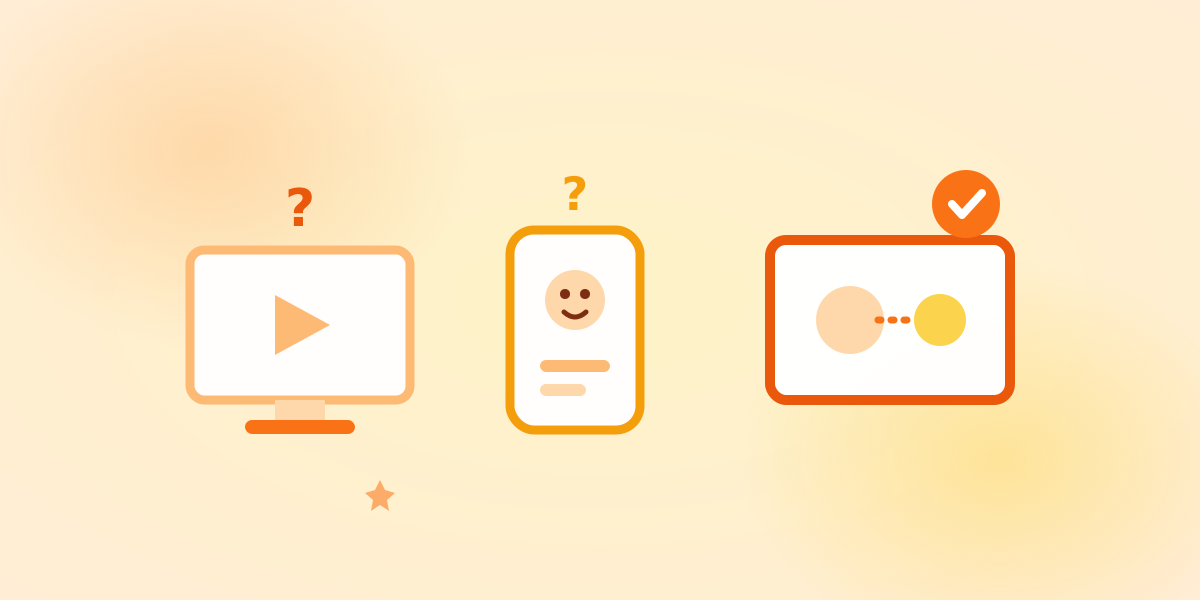
Short answer: Technically, “screen time” means any time spent in front of a screen — but counted that way, the number is nearly useless, because it bundles a video call with grandma, math homework on a tablet, and a three-hour autoplay session into one figure. The count that actually predicts anything sorts by what the screen is doing: passive consumption counts fully, interactive creation counts a little, and screen-mediated conversation barely belongs in the ledger at all. Here’s the sorting, item by item.
Every family that sets a screen-time rule hits the same edge cases within a week. Does homework count? Does FaceTime? Does music with the phone face-down? The confusion isn’t your fault — the term itself is broken. Let’s repair it.
The item-by-item answer
| Activity | Counts? | Why |
|---|---|---|
| Autoplay video, background TV | Fully | Passive, endless by design — this is what the research warnings are actually about |
| A chosen movie or show | Yes, but softer | Passive but bounded, and shared viewing changes its value |
| Video games | Mostly | Varies hugely — building games differ from idle-watching games |
| Homework on a tablet | Barely | The screen is a workbook; count the leisure screen, not the tool |
| Drawing, music-making, coding apps | Barely | Creation, not consumption — the screen is a canvas |
| Video calls with family | Almost not at all | Health guidance for under-2s specifically exempts video calls — telling |
| Audiobooks / music (screen off) | No | No screen is being watched; ears aren’t eyes |
| Talking to a voice AI | A little | It’s bounded conversation, not consumption — but it’s still device time |
| E-reading | Debatable | Closest to a book; watch sleep-adjacent use for light, not “screen time” |
The pattern behind every row: screens are a delivery mechanism, not an activity. “Screen time” measures the pipe, not what flowed through it.
Why the official guidance secretly agrees
The well-known limits — avoid under ~2, about an hour at ages 2–5 — come with two revealing footnotes: video calls are excepted, and viewing should happen with an adult. The people who wrote the limits were already sorting by kind. The exemption for video calls is the tell: a screen carrying a conversation was never the concern. What the warnings target is passive, unbounded consumption — the screen that never waits for your child.
A definition you can actually use
If you want one sentence for the fridge:
“Screen time” is time a screen spends entertaining your child without needing anything back.
Everything the research worries about — displacement of sleep and play, the marshmallow-drip of autoplay — lives inside that definition. Everything parents feel silly counting (calls, homework, making things) falls outside it. Our three-box counting method is this definition turned into a daily routine: put a timer on the flows-at-you box, and relax about the rest.
The two honest gray zones
Games. A sandbox-building session and a loot-box tapper are different activities sharing a screen. Sort by the same test — does it need things from your child, and does it have an ending? Anything engineered to never end counts fully.
“Educational” video. Content quality is real, but a lecture the child watches silently is still passive delivery. The education mostly arrives when someone talks about it — turns, not exposure, build learning.
Where a talking app lands
Our own product, sorted by our own test: KidTalk is device time, and we count it as such — but it’s bounded (a daily cap), it needs everything from the child (the whole product is the child speaking), and it can’t run in the background. By the fridge definition, it mostly falls outside; by honesty, it’s still not zero. We’d place it beside a video call, not beside video.
Frequently asked questions
So how much of the “real” kind is okay? Once you’re counting only passive consumption, the familiar guidance becomes usable: roughly none before ~2, about an hour with company at 2–5, and family judgment after that — with sleep, play, and homework as the real budget. Age-by-age detail here.
My child’s school issues tablets. Doesn’t that blow the budget? School tablet use is a workbook, not leisure — count it like homework, which is to say: don’t. Watch posture and evening light instead of minutes.
Does screen time before bed count differently? Yes — but for a different reason. Evening screens matter because of light and stimulation near sleep, which applies even to the “good” categories. A calm rule that outranks any counting: screens of every kind live outside the bedroom.
Is background TV really that bad if nobody’s watching? It counts more than people expect: background TV measurably reduces parent-child conversation in the room — it displaces talk without anyone watching it. Off is genuinely better than ambient.
In summary
- “Screen time” measures the pipe, not the content — that’s why the number feels wrong
- Count fully: passive, unbounded consumption. Barely: creation and tools. Almost not: conversation through a screen
- The official guidance already exempts calls and requires company — it’s sorting by kind too
- Fridge definition: time a screen entertains your child without needing anything back
- Bedtime is a light problem, not a counting problem
The next time someone asks how much screen time your child gets, the honest answer might be: “Which kind?” That question is the whole repair.
Ready to try KidTalk?
Turn your child's curiosity into stories with safe, friendly AI.
Get started for free