Tired of Endless "Why?" Questions? How to Survive the Why Phase
• KidTalk Team
Short answer: The why phase typically starts around age three and runs into early elementary school — and here’s the load-bearing fact: you don’t have to answer everything properly. Question storms exhaust parents for structural reasons, not for lack of love. Three cards get you through any day of it: an honest “I don’t know”, a returned “what do you think?”, and a “let’s look it up later” that actually happens. Held that way, the why phase stops being an endurance test and becomes the years when your child’s mind is most visible.
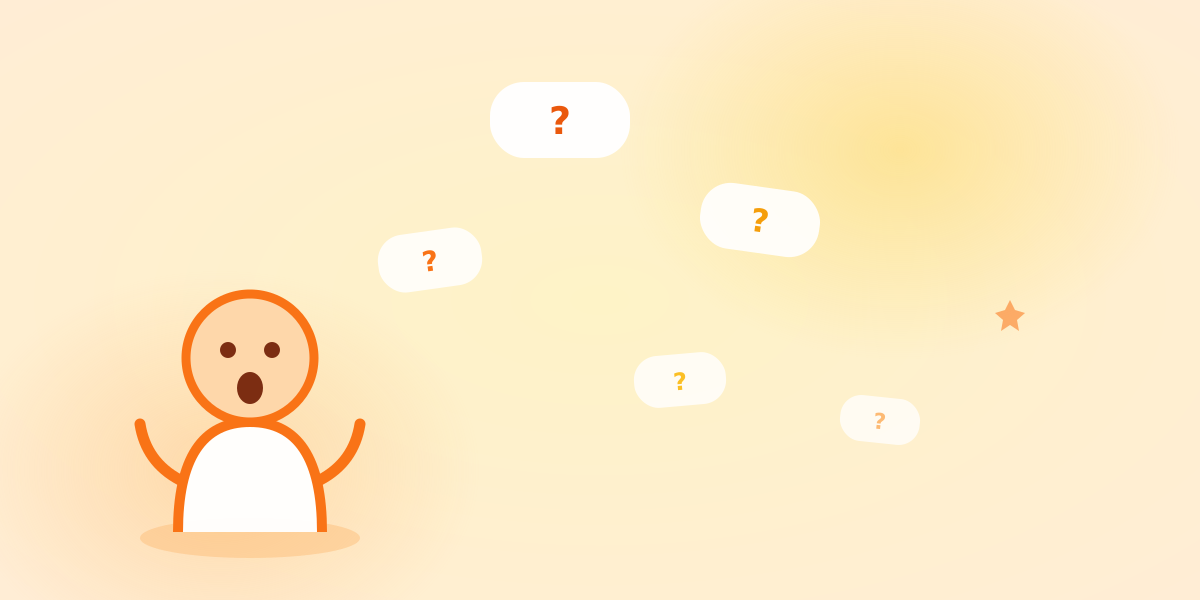
You’re cooking, and from knee height: “Why does water go bubbly?” You answer. “Why does hot make it bubbly?” Five whys deep, you wave the white flag — again.
First, hear this: that’s normal. And the storm is a good sign.
When does it start, and when does it end?
Individual variation is huge, but as a map:
| Age | What it looks like |
|---|---|
| ~2 | ”What’s that?” — the name-collecting phase |
| 3–5 | Peak “why?” — dozens a day is standard operation |
| 6–8 | Fewer questions, deeper ones |
| After that | The questions continue — but only to people who made asking feel safe |
That last row is the most important sentence in this article. Questions don’t fade because curiosity fades. They fade because children learn whom it’s safe to ask. Which means how you handle this year’s whys shapes what you get asked at fourteen.
Why it’s so exhausting
Before blaming yourself, look at the structure.
1. Questions never arrive at a convenient time. Cooking, driving, the checkout queue — they cluster precisely in the hours your hands are full.
2. The bar you’ve set is impossible. Almost no adult can accurately explain why the sky is blue. A perfect-explanation-every-time standard was never achievable, so stop grading yourself against it.
3. Many whys aren’t requests for information. Especially from small children, “why?” often means “keep talking with me” or “look at me.” The goal is the back-and-forth itself — which fits what the research says: language grows on conversational turns, not volume of explanation.
Five ways through
1. Say “I don’t know” with your head up
“Great question — I have no idea!” is not a failing grade. It’s one of the model answers. Adults don’t know everything, and not-knowing isn’t shameful: that lesson outlasts any single fact.
2. Return the question
“Why do you think?” flips the child into the answering seat. The hypothesis that comes back (“because a whale sneezed!”) can be gloriously wrong — if thinking-for-themselves has started, it worked.
3. Make “later, together” real
“Later” is a magic word if it happens and a lesson in futility if it doesn’t. Five minutes after dinner, one question, a picture book or a phone. One properly-honoured question a day is enough.
4. Sort the hard ones from the factual ones
“Why are traffic lights green?” and “why do people die?” are different species. The second is a big question with feelings in it — receiving it matters more than resolving it. Don’t rush those; we’ve written a full guide to them.
5. Don’t carry every question alone
A call to grandparents, an encyclopedia, an older sibling — and yes, an AI. Multiplying the places a question can land is design, not neglect. (Comparing candidates? See the app comparison — and if ChatGPT is on your list, the age guide for it.)
What an AI can and can’t be, in the why phase
Our honest placement:
What KidTalk can be is a back-and-forth partner for the hours your hands are physically full — age-tuned answers of two to four sentences, questions returned, and a history you can read, which turns into tomorrow’s “so what did you and Poppy talk about?”
What it can’t be is you. Some fraction of every “why?” means look at me — that question was never addressed to an AI. And the big questions with feelings in them belong to someone who can hug back. The daily conversation cap exists partly for exactly this reason.
Frequently asked questions
My child asks the same question again and again. For small children, the same answer to the same question is a check that the world is stable. They’re not failing to understand — they’re verifying. Answer short, answer the same, and don’t worry.
I gave a wrong answer once and they’ve repeated it since. A gift, actually: “Remember what I said about that? I got it wrong — here’s the real answer” is a live demonstration that mistakes get fixed. Worth more than being right the first time — same structure as handling AI errors.
My child barely asks questions. Should I worry? Question frequency tracks temperament far more than curiosity. Some children absorb the world by watching. Try aiming a “why do you think…?” at them and see what’s in there — often quite a lot.
When I return the question, they get cross. Sometimes they’re in answer-wanting mode. Then answer briefly and extend: “…and why do you think this one happens?” Roughly half answered, half returned is a good mix.
In summary
- Why phase: roughly 3 to early elementary; dozens a day is normal
- Nobody owes perfect answers — run on “I don’t know” / “what do you think?” / “later, together”
- A share of every “why” means keep talking with me
- The big feeling-questions get received, not resolved
- Multiply the landing spots; an AI can be one, and can’t be you
The question storm is genuinely tiring. But notice what it is: your child, wanting to know about the world — from you. The window where you’re the first person they ask doesn’t stay open forever. These are its best years.
Ready to try KidTalk?
Turn your child's curiosity into stories with safe, friendly AI.
Get started for free