Where Does My Child's Voice Go? Data and Privacy in Plain English
• KidTalk Team
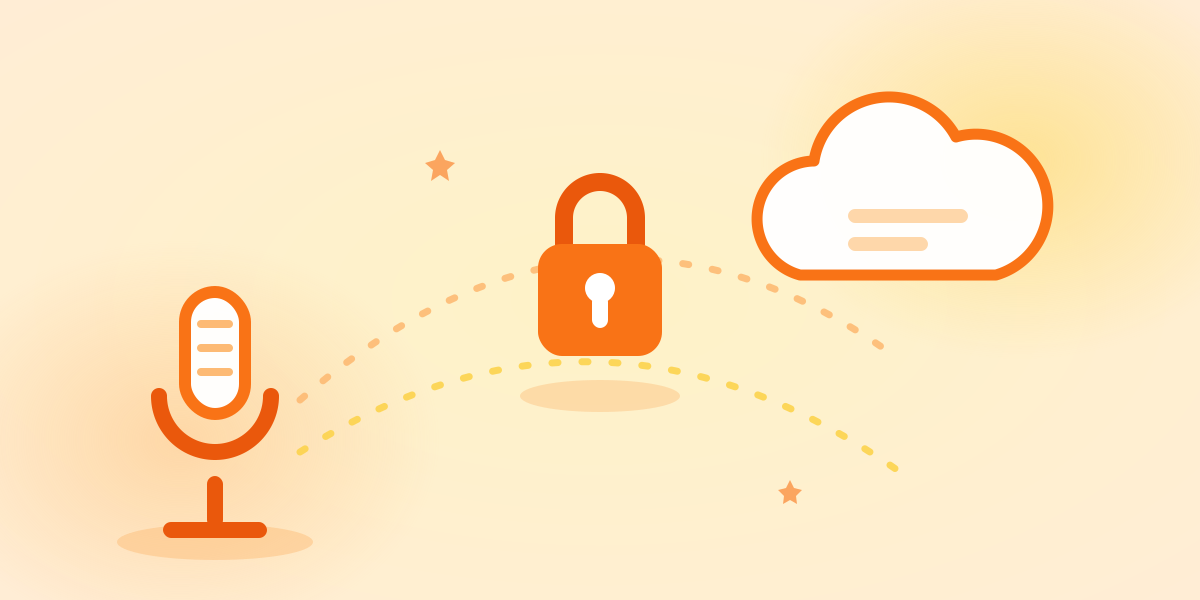
Short answer: The recording travels encrypted to Google Cloud servers in Tokyo, is turned into an answer, and is not kept — our servers hold nothing after the reply is sent. What is saved is the text of the conversation, inside your own account, so you can read what your child talked about. No advertising. No profile-building. No selling to anyone. And your child’s voice is never used to train an AI model.
Most privacy policies are written to satisfy lawyers. Necessary, but not much help when what you actually want to know is simpler:
My child spoke into a phone. Where did that go?
Here’s the whole journey, in order.
The journey of one recording
1. On the device — up to ten seconds
Your child holds the button and speaks. The phone or tablet records a maximum of ten seconds, held in the app’s memory. Nothing is saved to the device’s storage as an audio file.
The ten-second cap is a design choice with several jobs at once. It keeps replies fast, it keeps the conversation to genuine back-and-forth turns rather than monologues, and it means there is no long recording of your child in existence at any point.
2. In transit — encrypted
The clip is sent to our server over HTTPS, the same encryption your bank uses. In transit it cannot be read by your network, your internet provider, or anyone sitting on the same café Wi-Fi.
3. On our server — held in memory, never written down
This is the part parents most want to know, so we’ll be specific.
Our server is stateless. The audio arrives, is held in working memory, is passed onward for processing, and the memory is released. It is never written to a disk, never placed in a storage bucket, never stored in a database. There is no archive of children’s voices at KidTalk because nothing ever writes one.
4. At Google Cloud — Tokyo, and not for training
The audio goes to Google’s AI service, which listens to it and composes a reply, then to Google’s speech-synthesis service, which speaks the reply aloud. Both run on Google Cloud servers in Tokyo.
We use these services under a business agreement, which is what makes the important guarantee possible: your child’s voice is not used to train Google’s AI models. That is the difference between an enterprise cloud contract and a free consumer chatbot, and it’s worth checking for on any app you consider.
5. Back to your child — audio, then gone
The spoken reply comes back as audio, plays through the speaker, and is discarded. It isn’t saved as a file either.
6. What is kept: the text, in your account
One thing is saved: the text of the conversation — what your child asked, what Poppy answered — written into your family’s own area of the database. Reading it inside the app is a Premium plan feature; on any plan you can request a copy from us, and deleting your account deletes it.
It’s stored deliberately, for reasons we think are the right ones:
- So it can be seen. A parent who can never review what their child discussed with an AI is being asked to trust blind. Keeping the text is what makes review possible at all.
- So conversations continue. Remembering the last few exchanges is what makes a follow-up question work.
- So there’s a record if something goes wrong. If an answer is odd, it can be found and examined rather than argued about from memory.
Access is enforced at the database level: no other user can read your family’s history. Not by accident, either — it’s a rule the database itself applies to every single request, not a check our app code remembers to make.
What we deliberately do not do
Sometimes the absences matter more than the features.
| No advertising | There are no ads in KidTalk, so there is no ad network, no tracking pixel, and no reason for anyone to profile your child |
| No selling data | Not to advertisers, not to data brokers, not to anyone |
| No training on your child | The voice and the conversation are not used to train AI models |
| No card details | Payment runs entirely through Stripe. We never see or hold a card number |
| No real names needed | A child’s profile takes a nickname and an age. No full name, no photograph, no address |
| No long recordings | Ten seconds is the ceiling, by design |
The other kind of privacy — the household kind
Everything above is about companies. There’s a second kind that families think about, and it deserves a straight answer.
Should you read your child’s conversations?
For a five- or six-year-old, yes — and we’d recommend it. At that age it’s less surveillance than shared interest: seeing which questions came up tells you a great deal about what’s on their mind.
For an older child, we’d suggest telling them you can see it. “I can read what you and Poppy talk about” is a fair thing for a child to know. Secret monitoring damages something that’s hard to repair; open monitoring is just how the household works.
And the best use of the history isn’t checking. It’s conversation: “I saw you asked about volcanoes — what got you onto that?”
How to check any app, not just ours
These questions work on any children’s app. Ask them before you download.
- Is the voice data used to train models? Should be a clear no, in writing.
- Where are the servers? Vague answers are a bad sign; a named region is a good one.
- Is there advertising? Ads mean an incentive to build a profile. That incentive is the root of most kids-app privacy problems.
- Can you delete everything? Account deletion should remove the data, and the policy should say how long that takes.
- Can you read what your child said? If the parent can’t see it, ask why not.
- Who’s the company, and where? A named operator and a contact address, or move on.
More on evaluating apps in our 2026 checklist, and the formal detail is in our privacy policy.
Frequently asked questions
Is my child’s voice stored anywhere? Not on our servers. The audio exists in memory during the few seconds it takes to produce a reply, and is then gone. What’s retained is the conversation as text, in your account.
Can KidTalk staff listen to my child? There’s no stored audio to listen to. Conversation text sits in your family’s own area, which no other user can reach; internally, access is limited to what’s needed to operate and support the service.
Does Google get to keep the audio? It’s processed under a business cloud agreement, not the free-consumer terms, and it isn’t used to train Google’s models.
What happens if I delete my account? Deleting the account removes your data, including the conversation history. Retention periods for what has to be kept temporarily — payment records required by tax law, for instance — are set out in the privacy policy.
Is it safer to use it without an account? You can’t — talking requires a signed-in account. That’s deliberate. Anonymous use would mean nobody could review the history, and no parent would be accountable for the child’s usage. The account is a safety feature, not a growth tactic.
Do you comply with the children’s privacy laws? KidTalk is built for children under 13 and operates under COPPA’s requirements for parental consent, alongside GDPR and Japan’s Act on the Protection of Personal Information. Details in the privacy policy.
In summary
Where your child’s voice goes, in one line: to Tokyo and back, encrypted, and then nowhere.
- Ten seconds maximum, never saved as a file
- Held in memory on our servers, never written to disk
- Processed in Tokyo, never used to train models
- The text is kept in your account so that you can read it
- No ads, no data sales, no profile of your child
The question “where does my child’s voice go?” should have an answer a parent can follow start to finish. If an app can’t give you one, that itself is the answer.
Ready to try KidTalk?
Turn your child's curiosity into stories with safe, friendly AI.
Get started for free