Why Does AI Mishear Kids? Children's Speech, Misheard Names, and What Parents Can Do
• KidTalk Team
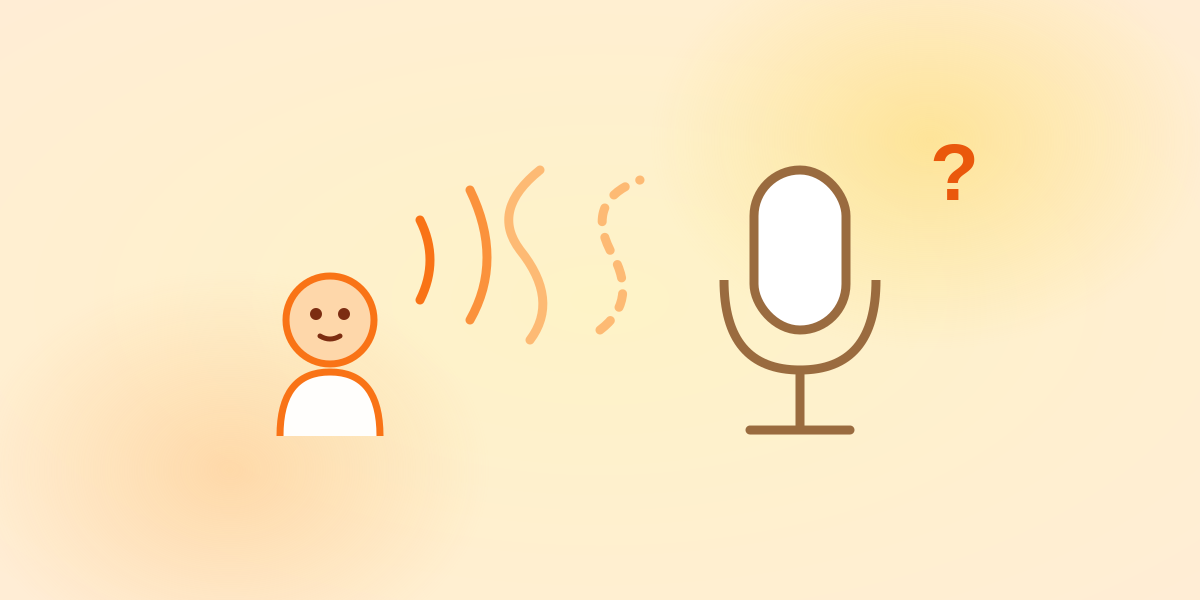
Short answer: Voice AI mishears children because children’s voices and speech differ a lot from the adult speech these systems mostly learned from: higher pitch, still-developing pronunciation, restarts and fillers, and words only the family understands. Some home habits (a quiet room, close to the mic, short sentences) help — but they won’t get errors to zero. And the error that stings most is a misheard name. That’s on us as the people running an AI to improve, and we’ll be upfront about it.
Two mishearings from our logs
From KidTalk’s conversation logs (part of our log-observation series; details altered):
- One child was called by a slightly wrong version of their name and corrected the AI: “My name is ___, not ___.” The AI apologized and used the right name from then on
- A heartfelt line from a child of about four was misheard as a greeting, and the AI replied off-target. The conversation ended after two turns
The first recovered; the second didn’t. We think the second kind — a child’s words going uncaught — is one of the biggest reasons a child decides an app is boring.
Four reasons children are hard to hear
1. Higher, differently resonant voices
Children’s voices are higher, and their shorter vocal tracts make speech resonate differently. Most voice-AI training data is adult speech, so a child’s voice is an “unfamiliar” voice.
2. Pronunciation is still developing
“Wabbit” for rabbit, “nana” for banana. Many sounds — r, l, s, th — are still developing until five or six or later. Parents decode from context; a first-time listener can’t.
As we wrote in Is 3 too young for AI conversation?, “speech that’s hard for machines to catch” still lingers at four and five.
3. Lots of restarts and fillers
“Um, so, um, today, um…” Thinking out loud is natural for children, but in a short recording, the actual point slides toward the end and gets harder to catch.
4. Words only the family knows
Pet names, nicknames, words the child invented. To a listener who doesn’t share the context, no amount of careful listening will decode them.
Why a misheard name matters so much to a child
For an adult, a slightly wrong name is a small thing. For a child, their name is who they are.
A child whose name gets mangled feels “it’s not really listening to me.” The child in our logs corrected it confidently — others will just quietly stop.
KidTalk passes the nickname from the child’s profile to the AI so it uses that name. Even so, it can blend in what it heard in the audio and say the name with the wrong sound. That’s something for us to improve.
Ways to help the AI hear your child
- A quiet room: TV or sibling voices overlapping drops accuracy sharply
- Close to the mic: hold the phone or tablet about a foot (30 cm) from your child’s mouth
- Short and one thing at a time: “We went down the slide at the park” rather than a long winding start
- Tap, then pause a beat before speaking: the very first sound sometimes isn’t captured
- If it mishears, try again: “Let’s say it one more time” doubles as practice in rephrasing
KidTalk lets parents review the conversation record (see Can parents see what kids ask an AI?). The record includes how the AI transcribed what your child said, so if mishearings seem frequent, it gives you a clue why.
How to explain mishearing to your child
So your child doesn’t conclude “I’m talking wrong”:
“The AI isn’t very good at hearing kids’ voices yet. It’s not that you said it wrong — the AI’s ears are still practicing.”
Knowing that AI can get things wrong is an important foundation for living with AI. Mishearing is the easiest example of it to understand.
FAQ
Should we use AI for pronunciation practice? We don’t recommend it. Most AI listening isn’t built to judge correct pronunciation, and a mishearing isn’t necessarily caused by pronunciation at all. If you’re concerned about your child’s speech sounds, talk to a speech-language professional.
At what age does AI hear children reliably? It varies a lot, but in our logs, conversations start meshing more often around age five — when speech gets clearer and children can say what they mean in fewer words.
Does mishearing increase when a child speaks their second language? It can — a child whose stronger language is Japanese will often pronounce English with Japanese sounds. The AI sometimes reasons from context and gets it right anyway; in our logs, it correctly understood a Japanese word a child dropped into an English sentence.
Summary
- Voice AI mishears kids because their voices, pronunciation, and speech patterns differ from adults’
- A misheard name hits a child especially hard — and it’s on us to improve
- A quiet room, close to the mic, short sentences: accuracy improves
- When it mishears, explain that “the AI’s ears are still practicing”
AI’s ears aren’t used to children’s voices yet. Which is why the best listeners a child has are the people who hear that voice every day. When the AI misses a word, you can be the one who catches it.
Ready to try KidTalk?
Turn your child's curiosity into stories with safe, friendly AI.
Get started for freeRelated Articles

November 16, 2026
Addition and Subtraction: What Age? Within 10 at 5–6, Carrying in First Grade, and Why Counting on Fingers Is Fine

November 16, 2026
Kanji: what age? 80 in grade 1, reading before writing, and stroke order you trace rather than memorise

November 15, 2026