English Words: What Age, and What Matters More Than How Many (Plus 500 Free Word Cards)
• KidTalk Team
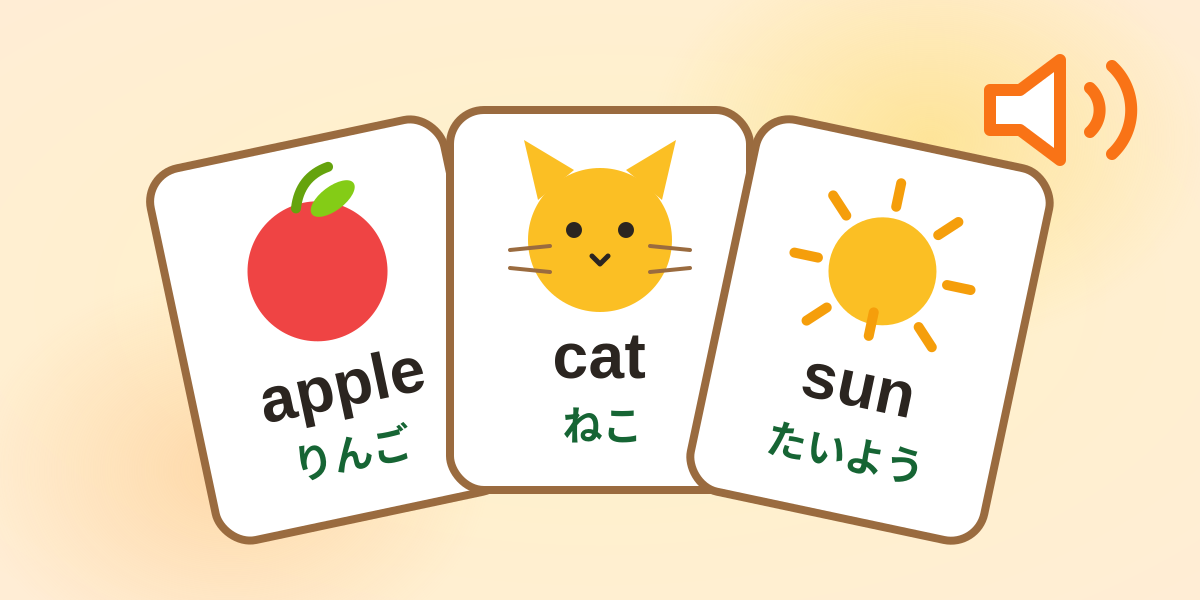
Short answer: Children can start understanding English words by ear at 3–4, saying them at 5–6, and reading and writing them from school age. The important thing is not to ask for all three at once. Asking a five-year-old to look at apple, read it and spell it makes English a chore; showing 🍎, saying “apple” and having them know it means りんご is a game even at three. This post covers what to expect at each age, what keeps it going at home, and the 500 word cards with emoji and audio we built for families raising Japanese-speaking children.
”Learning a word” is three different things
Knowing apple comes in three layers.
- Understanding it (receptive vocabulary): hearing “apple” and pointing at the picture
- Saying it (productive vocabulary): seeing an apple and producing “apple”
- Reading and writing it: linking the sound to a-p-p-l-e
The first language works in the same order. A child understands りんご months before saying it, and reads it in hiragana years later. There is no reason English should skip the order.
Layer 1 is also far larger than layer 2, even in adults: we understand many more words than we use. Early childhood is the time to fatten layer 1. “Can’t say it yet” is not a failure; it is the wrong layer.
By age: what to ask for, what not to
Ages 3–4: understanding, as play
Ask for: looking at a picture, hearing the English, and knowing what it is. Don’t ask for: saying it, seeing letters, or explaining the meaning.
Keep the words concrete — animals, food, body parts, vehicles. Abstract words (happy, big, come) come later. Use a real voice or a proper recording. A parent’s imperfect pronunciation is far better than no English at all.
Ages 5–6: saying, a little at a time
Ask for: saying the word when they see the picture. Praise when it comes; nothing happens when it doesn’t. Don’t ask for: pronunciation corrections. As we wrote in why we don’t correct children’s English, each correction costs you the next attempt.
A reasonable picture at this age: 200–300 words understood, 50–100 said. The numbers are what you find afterwards, not a target.
Early elementary: linking letters to sounds
In Japan, foreign-language activities start in Year 3 and English becomes a graded subject in Year 5 (what to do at home). School will bring the letters, so the home job is to have the sounds already familiar, so that reading cat at school feels like meeting an old friend.
The reverse — spelling first, at home — tends to produce children who can write words they cannot hear. It is a common pattern in families racing for Eiken grades, and it hurts in junior high.
Grades 3 and up: Japanese to English
Now add the other direction: look at the Japanese, say the English. This is the switch from receptive to productive, and it is what makes a word usable in conversation.
What matters more than how many
Most vocabulary apps sell “master 1,000 words”. For young children, three other things matter more.
- Frequency. Three minutes a day beats thirty minutes a week.
- The shape of repetition. Meeting the same word in different contexts on different days: flip it today, pick it by ear tomorrow, say it from the Japanese next week.
- “I don’t know” being safe. If a miss costs nothing, children flip the next card themselves — the same lesson as riddles and shiritori.
500 word cards with emoji and audio
Play & Learn › English word cards is the above turned into a tool.
- 500 words, 14 themes: animals, food, body, family, greetings, home, school, weather and seasons, vehicles, colours, numbers, clothes, actions, play
- Emoji as pictures: 🐱 🍎 🚗 — already on every phone, so nothing to load
- Letters first? The alphabet cards say the names of A to Z; come back here for whole words
- Both voices: English in Poppy’s English voice, Japanese in her Japanese voice, so no reading is needed
- Three ways to play: Flip (from 3, no score), Listen & pick (from 5: hear the English, tap one of three Japanese cards, ten per set), Japanese → English (school age: say it, tap to check)
- Ten at a time, unseen cards first. Free, no login, records stay on the device
270 of the words are the level-1 words of our typing tool: learn to hear a word here, then type it there.
Frequently asked questions
When should phonics start? Phonics maps letters to sounds, so it works best once a few hundred words are already familiar by ear. In Japan many families start in Year 1 or 2, and that is not late.
Does showing the Japanese stop them thinking in English? Not at this age. Linking to the first language speeds learning; “English only” is for later, once there is vocabulary to think with. The cards show only English and the picture until you flip them.
Is it fine for a parent to teach pronunciation? Yes. Listening to recordings together just keeps the child from treating a parent’s accent as the only correct one.
How many words for school or Eiken? Japanese elementary school covers roughly 600–700 words by the end of Year 6. There is no need to chase numbers early; 300 words understood by Year 3 or 4 makes school English enjoyable.
Summary
- Understanding, saying and reading are three layers; preschoolers only need the first
- Ages 3–4: concrete nouns with voice and pictures; 5–6: praise what they say; school age: letters and production
- Frequency and the shape of repetition beat totals; safe misses keep children flipping
- The 500 cards are free at Play & Learn, with emoji and audio
Ready to try KidTalk?
Turn your child's curiosity into stories with safe, friendly AI.
Get started for freeRelated Articles

November 16, 2026
Addition and Subtraction: What Age? Within 10 at 5–6, Carrying in First Grade, and Why Counting on Fingers Is Fine

November 16, 2026
Kanji: what age? 80 in grade 1, reading before writing, and stroke order you trace rather than memorise

November 15, 2026